The Portland Naturalist

The Portland Naturalist
Showing posts with label Bloxworth Snout. Show all posts

Tuesday, 10 June 2014

Italy Trip - Days 1 + 2

31st May

I wasn't totally sure what I was expecting from Italy, particularly in regards to the wildlife.  I suppose I was not expecting much to be honest, particularly as it's rarely mentioned as a destination for a wildlife holiday.  On top of that this was a family holiday, and I was doubtful that I was going to get much opportunity to get out to the best wildlife sites.

We (myself, my brother, mother and step-father) touched down in Rome late-morning, and immediately I was on the lookout for birds from the car, as we made the 2 hour journey south to the town of Formia.

Zitting Cisticola could be heard singing from any small patch of grass by the roadside, and plenty of Hooded Crow and a Black Kite was spotted.  Lots of Sparrows were heard and glimpsed, which of course were going to be Italian Sparrow, so the first lifer (depending on which authority you listen to of course!).

We stopped briefly near our rented villa by a flower-rich verge.  Straight away, quality was found with a Spotted Clover day-flying moth, and of course the Carpenter Bee Xylocops violacea.  Despite their abundance throughout the week, this was the best shot I managed!


As we pulled up to the house, I spotted something bold flitting about an Oleander bush.  As soon as I could, I headed out there to take a look.  It was soon found, and it was the stunning moth Nine-spotted.  There are a couple of similar species, but I think the wide yellow band on the abdomen suggests it to be the commoner, Amata phegea.


I went on to see plenty more throughout the week, particularly in our garden.  Talking of it, this was the view from our garden, across to the town of Gaeta.


Besides the Nine-spotted, there was plenty of stuff to be found here.  It was full of Olive trees and various flowers, including these commanding Cacti.


Even more dynamically, there were plenty of butterflies flitting about, including the Cleopatra.  Although at rest they closely resemble Brimstone, in flight they are unmistakable with bright red patches in the centre of the upperwing.


Along with Wall Brown, they proved to be commonest butterflies throughout the week.

There were a few birds around too, with a Sardinian Warbler singing in next-doors overgrown garden.  Also a few Serin, and the ubiquitous Swift, which is probably the commonest bird here.  I was desperately scanning the flocks in the hope of Pallid, which are in this region.  Instead I found an Alpine Swift cruising overhead, dwarfing the commons.

A Peregrine was a fitting end to the day, steeling in and scattering the vast Swift and hirundine flock.

In the local supermarket, some drinks companies know exactly how to win my favour.


1st June

Last night, I left the outside lights on in the hoping of attracting one or two moths.

It worked, with a decent selection sitting on the wall. 

One or two Geranium Wave Idaea eugeniata,


plenty of the Bee Moth-like Lamoria anella,
 

a few Lustrous Least Carpet Idaea filicata,


a single Least Black Arches relative, Nola chlamitulalis,


an unidentified Bee Moth-like individual, possibly a female Lamoria anella,


and lots of Rush Veneer.


Incidentally, the number of migrant moths (from a UK perspective) like the latter, was very great.  How many of these were locally-bred, and how many had come from Africa, I'm not sure.  Some more of those later.

Other than that start, there was little wildlife watching for the rest of the morning as we had a walk round the town.  The conditions were already scorching hot.

I did find this Weasel's-snout, a rare plant in the UK.


As well as this familiar Lulworth Skipper.


In the afternoon, we went somewhere right up my street, the country park of Parco di Gianola.

The woodland there was impressive.


And carpeting it was plenty of Ivy Broomrape.


There were a few more interesting butterflies at this site, such as familiar Swallowtail, and less familiar Mallow Skipper, and Ilex Hairstreak.

I also found this stunning large caterpillar feeding on Broom, which turned out to be the larva of the rather dull noctuid, Apopestes spectrum.


There was a good view from the end of the head.


The grassland here was alive with interesting insects, such as this bold Crambid moth Angustalius malacellus.


And this pretty Flower Scarab Oxythyrea funesta.


Plus, there were lots of Burnet Moths of at least two species present.  The Transparent Burnet (of the nominate subspecies, not as 'transparent' as the British subspecies) was far the commoner.


One of the most obvious creatures here, and indeed in much of the rocky and even urban areas around the place, was the Wall Lizard.  The sound of them scuttling for cover from the edge of paths was an almost constant accompaniment to our walks.


There were a number of Roman ruins at this site, though the amount of mosaic remaining was rather pitiful.


We found ourselves in a tiny Roman harbour, and this turned out to be a good place for rock pooling.  There were lots of Sea Anemone, which looked their most stunning out of water.

 
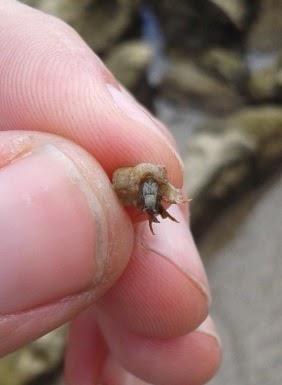
 Plus, I somehow spotted this minute Hermit Crab scurrying amongst the silt.


The route back through the woodland took us past a colony of Alabonia geoffrella. A species I've noted in the UK and France in the past.


Before we made it home, we went up the road to a holy shrine, which happened to be in a cave.  The place was full of Bloxworth Snout. 


In the evening I again put on the outside lights, and held a vigil by them for a while.

To my surprise, I spotted a number of Firefly flitting about the place, flashing their bioluminescent final segment to their body.  I had no idea we had them in Europe.  Turns out they are closely related to our Glow-worm.


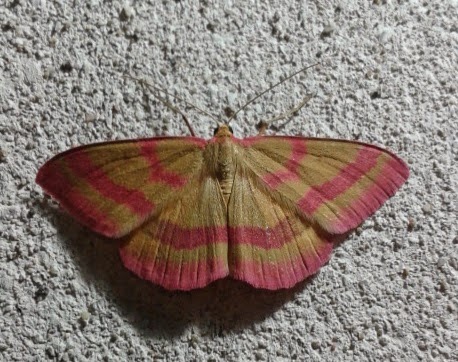
A moth did eventually show up, and it was worth waiting for.  The stunning Narrow Rose-banded Wave Rhodostrophia calabra.


A promising start to the trip!

Tuesday, 11 March 2014

Egghead!

Quite a bit to catch up on, and I've let the photos build up a bit too much!  Nice to be able to report on some non-bird stuff for a change though. Spring is here!

5th

I was up at the break of dawn, and what a dawn.


The best find from this mornings usual excursions was a 1st-winter Rook near the start of Reap Lane.  Very unusual away from Ferrybridge, this bird with it's developing pale base to the bill, was a surprise sound as it called from a lamppost.  Not a sound I expect here!  It was indeed very vocal, and presumably it was pining after some company.

6th

All the usual stuff, including the two Iceland Gull again in Chesil Cove.  What was more surprising was a pair of Pintail, which passed at middle distance.  A Portland tick!

At Ferrybridge, I made a point of photographing a more expected Rook, as the bird went backwards and forwards cashing pieces of a large chunk of bread.

 
Whilst on my second look at the Cove, I heard the Gulls getting animated.  Usually it's the Buzzards or Peregrines that set them off.  I looked up towards the Verne to see a large, slow-flapping Accipiter raptor, with flared out undertail coverts.  I rushed to get my camera, but once I'd set up, the bird had vanished!  I'm not going to tick it, but I can't see how it couldn't have been a male Goshawk!

Later, on a break from work, I popped into Ferrybridge.  I was greeted by two flocks of waders (adding up to 17) flying back and forwards over the sea/beach/Fleet.  I only had my bins, so hence I had my second frustrating moment of the day!  They seemed to have a lot of white on them, but clearly weren't Black-tailed Godwit.  So I concluded, probably wrongly, that they were Redshank.  They did seem to appear from the sea first, which is why I thought against one of the Fleet resident species e.g. Bar-tailed Godwit.  It's too early for them to be moving.

7th

My usual looks at Reap/Barleycrates/Suckthumb produced little to shout about, but what a beautiful day!  I looked at the jungle that is Barleycrates Lane from a different perspective!

 
Whilst here, I took my first proper look at the galls which cover the leaves of the Alexanders.  They are caused by the fungus Puccinia smyrnii.


Back at Chesil Cove, in addition to the usual 1st-winter Iceland Gull, the 2nd-winter Kumlien's Gull appeared from nowhere, before flying away along the beach.  A couple of swipes from the nearby Herring Gull revealed it's dark tail.  I wish it would settle down and give itself up to all!

Also in the Cove, the usual stuff, plus 26 Brent Goose, and a load more which looked like they were coming, before peeling off at the last minute and landing at Ferrybridge!

8th

Chesil Cove first thing had promise, as a south-easterly was blowing.  Sadly, I couldn't take advantage of it as I was working the morning.  I only had time to see another 28 Brent Goose south, although they strongly thought about going 'up and over' the island.

Whilst working, I very fortuitously stumbled on a Bloxworth Snout moth settled by a window.  An increasing scarcity.


After work, I had my usual stroll round the place, and found my first migrant Chiffchaff at Barleycrates Lane, and identified for the first time, Common Whitlow-grass (not a grass at all, but a member of the cress family) along Reap Lane.


After that, I left for Surrey, as I was spending the weekend back at my old haunt. On arrival at my old garden, I was greeted by a singing Blackcap!  My first of the year!

9th

The reason I was back in Surrey, was because I was leading a walk for my old local RSPB group on the South Downs at The Burgh.  Before that though, I just had to pop into the former local patch of Tice's Meadow.  It was the start of another gorgeous day.


The water level there was the highest it has ever been.  The whole place is one big lake!  Little of note on the bird side though, except a long-staying female Shelduck, and my first chicks of the year.


After a great meet-up with my old Tice's pals, it was onto the walk.  It went pretty well in perfect weather.  The site wasn't quite up to it's usual self though, with quite a few hoped-for species missing.  We still saw the likes of Grey Partridge, Raven, Red Kite, and Yellowhammer everywhere though.  Loads o butterflies on the wing including Peacock and Brimstone.

10th

I couldn't resist another quick look at Tice's first thing.  Again, nothing particularly notable for the site, but it was just brilliant seeing the likes of  Shoveler and Bullfinch, species I just don't get to experience anymore being at Portland.


And, although I do see them at Portland, the Common Gull were looking smart.


I then also popped briefly into Frensham Great Pond, for no real purpose.  I miss this place as well!


A Firecrest, and best of all, a singing Woodlark (my favourite songster) were very welcome here.

I made my way home to Portland.

On arrival, I felt I had to have a quick nip around the place, seeing as the Wheatear had finally turned up!  No luck with those sadly, but I did happen to bump into a pair of Peregrine eating a Woodpigeon at Barleycrates Lane.  Plenty of calling and interaction going on, but sadly the female had had her fill, and had left the male to it by the time I got into a position to photograph the action.


Today

A number of birding sessions finally yielded the winter thrushes, as at least 11 Redwing were scattered about the place (2 at Barleycrates, and 9 over Suckthumb), along with an obvious increase in Blackbird and Song Thrush.  2 Fieldfare were also at Suckthumb, as was two Firecrest still, and a Woodcock which I flushed from the side of the raised area.

A brand new fungus discovery was this nice troop of the wonderfully named Egghead Mottlegill, by The Hump.


A quick look at Ferrybridge revealed the Iceland Gull still, seemingly settled on the pools by the car park.  And last, but certainly not least, a stint at Chesil Cove revealed a distant pod of 3-4 Bottle-nosed Dolphin, whose presence was revealed by their attendant Gulls. 

Still no Wheatear for me though!

If you've made it this far, congratulations!