The Portland Naturalist

The Portland Naturalist
Showing posts with label Fox. Show all posts

Thursday, 29 May 2014

Provence Trip - Day 5

This night was affected by a huge thunder storm, and none of us got enough sleep as a result!

Day five dawned to a mutiny in the camp!

Most of the group were keen to go off to the local market, leaving just the two of us who wanted to go birding!

Luckily, Craig was able to take us keen ones out for the morning in the smaller vehicle.

We just stayed local, first just checking whether those pesky Eagle Owl were back at their roost. They weren't.

So, we headed up into some scrubby habitat not far from where we were on the first day.

A Hobby immediately appeared above us, and proceeded to chase House Martin, coming very close indeed.

The plants and insects were of particular interest here, with familiar things like Chicory...


...and some less so like Berger's Clouded Yellow.


At least four Ortolan Bunting were singing competitively around us, with one bird showing itself off particularly well.


What a spot this was, with plenty of Lesser Butterfly Orchid around.


This large beetle caught my eye, and I found out later that it's the wonderfully named Peach Flathead Root-borer (Capnodis tenebrionis), the pest of the local Apricot fields that Andrew told us about.


Lots of Rose Chafer beetles buzzed around too.

After a quick look at the massed Griffon Vulture resting on a cliff, we proceeded to a wooded area along the banks of a river, a favoured area for woodpeckers of four species.

Rather predictably, we only encountered the two commoner ones, with Wryneck in particular evading us again!  They are supposed to be common round here! 

What we did manage to see though, was the strange sight of a pair of Crossbill fledglings sitting about in deciduous woodland, plus yet more interesting plants and insects.

These included this pretty Goat's-beard...


...and a few more daunting Fritillaries, though this one stayed still enough to prove it to be a Glanville Fritillary.


Also in this area were a few Hornet, a Burnet Companion moth, and the largest Ants I've ever seen.

We headed back to our accommodation to meet up with the rest of the group for a lovely lunch, eaten on my spacious veranda.

In the afternoon there was a threat of rain, so we again headed out to a couple of local places.  The first was a walk through the strange oil shale landscape.

Orchid were again prominent, such as this Woodcock Orchid.


Plus, we finally found a Lizard Orchid in flower, just.
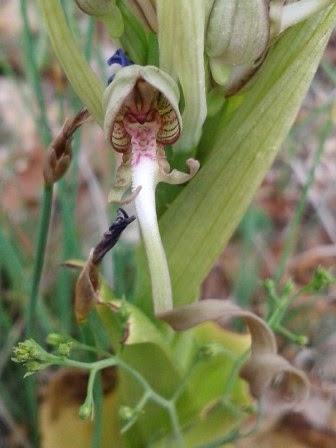

Whilst I knelt down to take this picture, someone spotted something behind me.  It was a terrific find sitting brilliantly camouflaged in the vegetation.  The local Praying Mantis, called the Conehead Manits!  What a beast.


I experimented with taking photos through my scope from a distance.


We reluctantly moved on, and found a load more goodies, such as this Common Broomrape (form maritima, as its parasitizing a species of Eryngium (Sea-holly family))


Someone did well to spot this Fox, staring at us from the other side of a deep quarry-like depression.


Time to move on, and we headed for a fantastic heath-like habitat, not looking for anything in particular.

Whilst here, we had more views of Rock Sparrow sitting on wires, Red-backed Shrike, Tawny Pipit and Ortolan Bunting all showed well, plus we added yet another Orchid to our trip list, Fragrant Orchid.


Despite the increasing dark clouds, I picked up a large raptor being mobbed by a smaller one.  Round here, there's a good chance that any BOP in this situation is likely to be a Golden Eagle, and indeed this was!  A Peregrine was having a right go at it.

We had got pretty far from the vans by this stage, so it's no surprise that the heavens chose this point to open!


Luckily, it was near the end of the day anyway.

By the time we had got back the rain had stopped, so I thought it was worth a quick nip out before tea.

I headed up a road from the village cause I'd heard that an interesting Orchid had been found.  Indeed, there it was by the road, the absent from Britain Violet Bird's-nest Orchid, with its flowers not quite out fully.  Still a spectacular thing.


Also here I found some Slender Broomrape...


...as well as plenty of Roman Snail enjoying the damp (here with Garden Snail for comparison).


The first day of the week with no bird lifers, but still very enjoyable.  That will all change tomorrow I hoped, as we are headed for the semi-desert of La Crau!

Provence Trip - Day 3

20th

It was a long drive, but we felt it was all going to be worth it, as we visited the world-renowned vast wetland of The Camargue.
Even before we got there, I had spotted a Squacco Heron on the edge of a rice paddy field, and we drove slowly past a dry field that had a few Crested Lark in it.  A distant flock of Glossy Ibis were also spotted.
As soon as we exited the vehicles at the first stop, we were hit with an appallingly strong wind.  Would this put a real downer on the day?
The first place we stopped had reedbed and freshwater pools on both sides of the road, and although these were hidden by reeds, we had a constant stream of birds making their way from one to the other.
Several male Red-crested Pochard were seen in flight, a Hobby flew over, Purple Heron were building their nests…


…and Whiskered Tern were on the move.


It was amazing that anything was making itself heard in the wind, but I was still able to pick out the grating song of a Great Reed Warbler, alongside their smaller cousins.
At one point, I noticed three darker herons flying in the distance. Surely Night Heron, I thought.
Black Kite were the commonest bird of prey, and a few Marsh Harrier were quartering about.  Just before we were about to leave, two Great White Egret took flight.  A smart spot!   

We headed for a comfort stop at a visitor centre.  In the car park, the ubiquitous Melodious Warbler sung.


The ‘song’ of the Zitting Cisticola (Fan-tailed Warbler) was all around, but they were only distantly seen in flight. 
Andrew wanted to show us a White Stork nest, but was surprised to discover the tree had gone!  Probably fallen in winds like those we were experiencing!
We moved on to a fabulous viewpoint over the marsh, and our first views of the famous Greater Flamingo.


Before this, as I got out of the van, I disturbed a huge Locust, probably a Migratory Locust (Locusta migratoria), but it fled before I could get a photo.
The lifers came thick and fast at this spot.  A male Sardinian Warbler sung nearby, and I eventually saw it, although briefly.  Over the wetlands two Gull-billed Tern hunted. We went on to see a few more, including one resting in a flooded field.


After a great deal of squinting, I somehow managed to find some of the hoped-for Collared Pratincole, but they were right at the back, mostly hidden by vegetation.  Just occasionally one would fly up and show off its distinctive flight and white rump.

Meanwhile, a Fox was worrying the colony of Black-winged Stilt.


To add to the birds hunting low over the water, two young Little Gull were found, as were a few Black Tern.  Last, but not least, Craig found us a sparkling adult White-winged Black Tern into the bargain.  That’s all the European marsh Terns in one spot!
Just before we left, I managed to get a good view of a Zitting Cisticola finally, sitting on a bush.

We reluctantly moved on, but it wasn’t long before we ground to a halt once again.  First, we came across some intact White Stork nests…


 …and then we had a couple of Bee-eater fly over.  Some movement in a horse field revealed themselves to be the bulk of the Collared Pratincole colony, so finally we could get good views.


The Bee-eater we had seen earlier, were now hawking about over the same field, and as we left they were sitting in bushes right by the road.  The only Tree Sparrow of the week flew past.
We moved on to a lunch spot, chosen more for the shelter it offered rather than anything else!

It didn’t stop us looking for wildlife though, and I found this Birthwort, a rare farmland plant in the UK.


The only unusual ornithological observation here was a distant loose group of four Kestrel hunting.  I’ve never seen so many Common Kestrel hovering so close to each other for so long before, and Andrew suggested they were probably Lessers.  Unfortunately, they were just too distant and into the sun to pin them down, but I did try!

We then started to make our way slowly towards the sea, alongside the saltpans and the mouth of the Rhone.  There was a myriad of small waders about, such as the plentiful Kentish Plover.


This Curlew Sandpiper was a treat in summer plumage.


And, there were a lot of Little Stint about (plus Sanderling).


But, one of the main targets was the Slender-billed Gull, and we had no trouble seeing them as they flew past to bathe in a nearby tidal pool.


Yellow Wagtail (Blue-headed) were everywhere, as were Yellow-legged Gull and Avocet.

We eventually made it to the sea, but the strong wind meant we were battered by a sand storm!  In the brief moment we were out of the van scanning the sea, we were able to spot distant small Shearwater, probably Yelkouan Shearwater, and I found one or two huge brown Shearwater in addition, no doubt Cory’s Shearwater.  We also had a few Black Tern go past, and then fly off inland.

We stopped off at another viewpoint and comfort stop on the way back, and I flushed a Night Heron from by the entrance.  Plus, I finally got a glimpse of a distant Great Reed Warbler singing from near the top of a reed stem.  Another tight flock of Black Tern whizzed by, clearly migrating.

We made it back home eventually, and we commented how we’d seen all that on a very windy day.  What must the birding be like in perfect conditions!?  It was another long day, but a very satisfying one!

Later in the evening, someone found this Oak Hawk-moth roosting on a fence.  This was the only nocturnal moth I was able to see all week, as although a moth trap was available, it wasn’t being run sadly.


Back up the mountains tomorrow…