27th May
I set up at the West Cliffs in the hope of some late vismig, not expecting a great deal. At one point I noticed four distant birds flying with a bounding flight towards Southwell Business Park. I couldn't make out any colours, and the shape was indistinct, but I put them down as Skylark.
After giving up, I checked Twitter and found that a party of four Bee-eater had been commuting around the south of the island for last hour or so. They had to be the birds I saw earlier! I immediately went back out to try and find them again.
Almost immediately I found four very promising looking birds flicking about behind Southwell Business Park, again too distant to pick out any detail. I contemplated trying to get closer, but with them being so mobile, I thought that was a bad idea, and I instead stayed put in the hope they might fly in my direction.
They had been out of view for quite a while, when I thought I glimpsed one over Southwell, heading north. Not long after, I glanced over towards Suckthumb Quarry, only to find all four Bee-eater hawking over it!
I jumped in the car and zoomed round there. They weren't immediately obvious, but as I jumped up on one of the boulders by the entrance, they all flew up from a Bramble bush! They flew around a bit, then headed off north towards the windmills.
I think me seeing my first ones in France just last week definitely helped me initially pick them up at distance from their flight action etc. A cool UK tick!
8th June
I was in Surrey today in transit from Italy, and due to head back to Dorset. I was hoping the Short-toed Eagle was going to be pinned down in the New Forest, so I could do a conveniently-placed twitch. Sadly, it wasn't to be, though as I was seeing them literally two days ago in Italy, I wasn't too disappointed.
Instead, I headed to my beloved Tice's Meadow, not expecting a great deal.
It was nice to see the breeding Black-headed Gull and Common Tern doing well on their new raft.
Suddenly, I found a Little Tern flying around amongst the close Terns. That's two short visits to the site in a month, and two Surrey rarities! Also a first for the site I think.
It stayed about for a little while, before seemingly heading off high North-east. I later discovered it had earlier been at nearby Fleet Pond.
13th
A new arrival was worth heading for at the Bill.
As soon as I got to the Top Fields, I could hear the Thrush Nightingale singing it's incredibly varied and powerful song. I set up for a vigil, as it sang from very dense scrub.
While waiting, there were a number of Magpie Moth flicking about, the first time I can recall seeing them flying actively in the day.

Myself and the rest of the small crowd kept watch for some time, but despite several further enthusiastic periods of song, the bird failed to show itself. Not all that surprising really.
I headed back home via various sites in the hope of bumping into the Hooded Crow that had earlier flown north from the Bill.
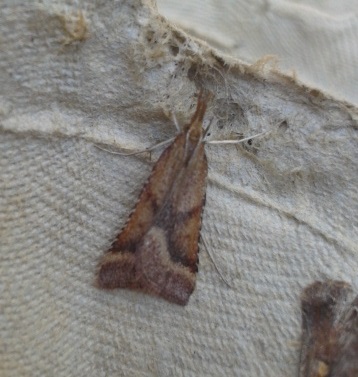
In Suckthumb Quarry I came across a Thistle Ermine.

Also here, I found a plant I didn't immediately recognise. All pointers seem to suggest it was Marsh Pea, which is very rare in Dorset. More on this later.

14th
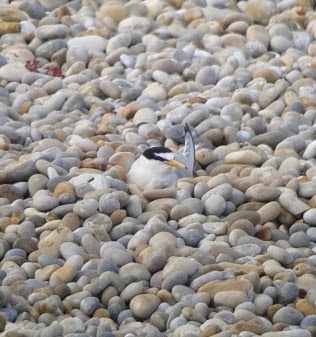
This evening was my long-awaited first guarding of the Chesil Little Tern colony.
They were great to watch, chasing everything that even came close to the colony, even Great Black-backed Gull!
They are doing so well, with 18 chicks at this point, and loads of eggs about to hatch. I was keeping a close eye on two particular pairs that were next due.
There was plenty of other birds to be seen, such as a surprise fly-over Redshank, and a Gannet in Portland Harbour oddly.
The other interesting sighting concerned a summer-plumaged Plover which was initially thought to be a Grey. But, when seen head on, it had a distinct golden tinge to it, something which is also evident in the pics I took (particularly the first one).


Seen close-up, it clearly had several yellow feathers in it's crown and mantle. I was seriously thinking it may be a 'lesser' Golden Plover.But, it was later flushed as the Little Tern project co-ordinator Morgan (who incidentally, was also convinced the bird was a Golden Plover sp.) went to check the colony, and it revealed itself to be a Grey Plover with its call and underwings!
Presumably, I was caught out by the fact that I've just not studied summer-plumaged Grey Plover in that much detail before!
I watched the sunset from my beach-top vista.

It was at this point when the Chesil Hare began to show themselves, and the Terns went just as mad at them when they entered the colony as when the Gulls do!

Just before I was about to leave, I took a last glance at pair number 8, only to see the bird on the nest looking very restless. Eventually, I got a glimpse of a newly-born chick sticking its bill out the edge of the nest. New arrivals!
15th
I found a Drinker moth caterpillar on the pavement whilst out working.

16th
After a couple of missed opportunities (including me failing to find the Grove pig farm!), I finally managed to see the long-staying Hooded Crow at the Grove. It took a while to appear, but eventually showed itself among the flock of 80 or so Carrion Crow. A nice Portland tick yes, but its not within my patch. Its flown over the patch several times now, without me getting on it!
21st
My second stint watching the Little Tern was less eventful than the first, but it was great to see 55 chicks doing so well, and on the dead calm sea, the adults were finding it so easy to catch fish. At one point, one pair brought back three fish in the space of five minutes!
They are getting big now (for a Little Tern!).


22nd
Straight after the Terns, I headed to Broadcroft Quarry to see how the moth trapping was going, on a Butterfly Conservation event.
It looked promising in warm conditions.
The next morning we emptied the three traps.

The total of 120 odd species was one of the highest I've ever experienced. Despite this, there were no new macros for me, but there were a few good micros. Some of the lifers for me were Aethes beatricella, Pelochrista caecimaculana, and Delplanqueia dilutella.
After that, we went on a butterfly walk. Among the highlights were Small and Silver-studded Blue.
Also among the highlights were the Shieldbug Eurygaster testudinaria.

Plus, I was finally able to solve the 'Marsh Pea' mystery, as the plant was everywhere here. It turned out to be Slender Tare, which is a speciality of the site. Not as rare as I'd hoped, but still a lifer for me.

Not a great deal of wildlife watching on the horizon, though there are a number of moth events coming up, and will I finally get the chance to see that pesky Short-toed Eagle?