
I'd left the outside light on once again, but the only different moth to be found was two Waved Umber.

Today, we were heading up to the mountains, and the Monti Aurunci national park.
Once we'd headed up a very narrow twisting road up to a 'refuge' and car park, I was able to go off on my own and go at my own pace. The view from this gravel track across a wooded valley was great.


My pace incidentally, turned out to be very slow, as I was constantly distracted by birds, and particularly butterflies. Immediately, I traced an unfamiliar 'tacking' to a pair of Subalpine Warbler, and found Pearly Heath and Great Wall Brown (below, underside and upperside) butterflies.

A Cuckoo was making it's presence felt, and I heard the fluting of a Golden Oriole somewhere down in the valley.
Viewing up towards the summit of a nearby rocky crag, I found Tawny Pipit, and got a glimpse of a Wheatear sp in flight. There are Black-eared in the region.
The vegetation was very impressive with these absolutely massive Milkwort sp.

and the Hairy Canary Clover, which I'd unexpectedly found an example of on Portland last year.

A strange lack of Orchids though.
I'd not gone far down the track, when I heard a strange high-pitched whistling, and found one of my main targets staring back at me from an adjacent tree. A fabulous Rock Bunting (carrying a Stick Insect!).

There were two birds, and I suspect I was close to their nest.
I went on to see plenty more, in fact at times they were the commonest bird of all!
The butterflies continued to show, including several types of confusing Skippers. A Marbled Skipper made a brief appearance, but this one was more obliging.
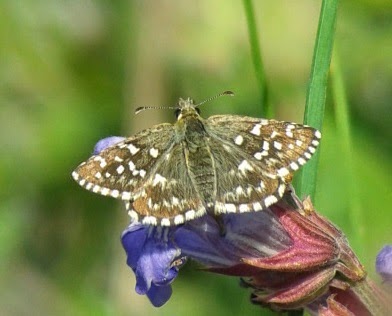
This could be any one of Large Grizzled, Yellow-banded, Grizzled, or Southern Grizzled. If anyone wants to take a stab at it, be my guest!
There were also a lot of Italian Marbled White about, but they rarely alighted.
After a while, I came across a crossroads, complete with a board and map. It was needed, as I had no map of my own! With this I was able to formulate a circular route back.
This route took me into some relatively birdless Hornbeam woodland.

There were some Marsh Tit and Short-toed Treecreeper in there, plus a worn Green Hairstreak, doing it's best to look like the rare Provencal Copper! Also a Pearl-bordered Fritillary.

Back out into the open again, and yet more bewildering Fritillaries to get my head round, such as this female Spotted Fritillary (there were also males around, easily identified as being the brightest orange of the lot).

Best of all though, was several Queen of Spain Fritillary.

There was a good selection of raptors around, with a Hobby whizzing by, a distant soaring Short-toed Eagle, and a single female Honey Buzzard, which plunged down into a small copse of trees, presumably to search for Wasp nests.
Whilst under a canopy of trees, I heard some Bee-eater calling, but they sadly went unseen.
There were a great variety of day-flying micro-moths about, but most went unidentified, unlike this Chrysocrambus craterella.

The route I had to take back to base, led me down the steep rocky side of the mountain, on a very under-used and indistinct track! The view over Formia and Gaeta from the top was spectacular though, and this is where I had lunch.

As I descended, I found a whole new community of wildlife surviving in this rocky environment, such as a fleeting shiny blue Forester moth Rhagades Pruni, and a more convincing Yellow-banded Skipper (the yellow bands are on the underside of the hindwing).

But, the star of the show was a Rock Thrush, which I found by following it's quite Blackbird-like song. The heat haze was a pain though.

Along with Rock Bunting, that's another that we tried for and failed 2 weeks ago in France.
More trip ticks were a singing Woodlark, a Raven, and a bog-standard Northern Wheatear, proving my earlier brief sighting.
A fantastic walk, but I probably only successfully identified a fraction of the Lepidoptera seen!
In the evening, a quick look at the outside lights produced little new on the moth front, except this Hoary Footman.

Onto a ferry tomorrow.


