Not a massive amount to catch up on up to the end of the year, with few birding opportunities. You might say I've been in hibernation (or you could just call me lazy!).
Either way, it was nice to pop back to Surrey on the 14th December to lead a walk at the picturesque Puttenham Common. It was even more so in the frosty conditions.
Just the usual species of note, including 2 Kingfisher, lots of Mandarin, and 2 brief Raven.
It had to be whilst I was away that a longed-for Caspian Gull occurred at Radipole. I put a bit of time in the following couple of evenings, to no avail. Just the usual alarming Herring Gull variation.
On the 21st, I joined a meet of the guys from A Focus On Nature - a group for young conservationists, at Slimbridge. I hadn't been for quite a while, and I'd forgotten just how many birds the place holds!
One of the highlights though was a glimpse, on a big screen (due to quarantine regulations), of the Spoon-billed Sandpiper and a talk about Slimbridge's internationally important captive-breeding and release programme.
Of the wild birds though, the sheer numbers were breathtaking, especially at the evening feed...
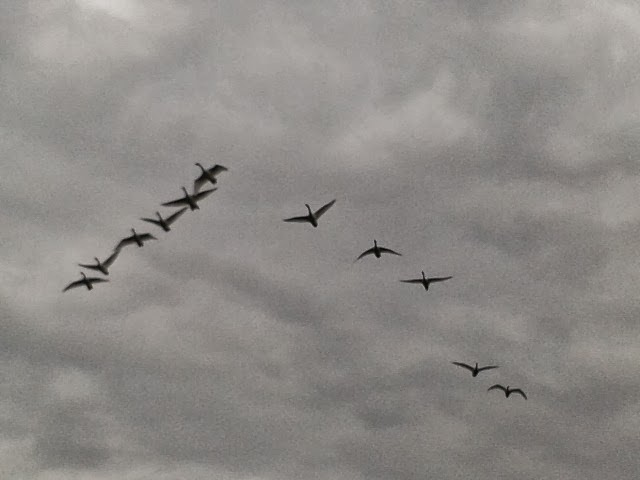
The best species were a small flock of White-fronted Goose, 2 Marsh Harrier, a distant and brief Barn Owl, a Little Stint, and a Whooper Swan, which appeared late-on at the feed.
The best bit of the day for socially-inept me though, was meeting so many wonderful like-minded people. We are strongly-positioned indeed to preserve the worlds wildlife in the future.
One of the sites at the forefront of wildlife preservation in my home county of Surrey is Tice's Meadow. I was able to pop back in there briefly on Boxing Day. Nothing of massive note species-wise, but great to see the place looking top-quality in habitat once again!
In terms of Portland birding, the only notable sightings during this period were a Firecrest or two still at Penn Castle Woods, and a few birds in the Harbour including a surprise pair of Velvet Scoter which flew in at Portland Castle on the 29th, dropped their landing gear, but changed their minds and flew off. Could've been an unrivalled photographic opportunity in the sunshine! Oh well.
So, I failed to add to my patch list in December, and finished on 177 species and 278 points. It'll be tough to keep up with that in 2015!
Hope you all had a great Christmas, and may I wish you a spiffing and bird-filled new year!
Day 4 brought absolutely appalling conditions, with frequent rain and a wind of around 40 mph!
Despite this, I was determined to get out there, so while the rest of the group sheltered at the Obs and the museum, I walked all the way to the South Light. I was rewarded in this area with a single Purple Sandpiper and the first Woodpigeon of the trip!
The geos (deep coves) along the west coast were full of birds sheltering from the easterly wind, including loads of Thrushes and the first Siskin.
My walk took me up one of the moorland hills, where I was hoping to find a Dotterel, seen yesterday. Here you can see part of the airstrip.
Just a few Golden Plover, and a soaking later, nothing of note.
After lunch the rain had eased, so we all ventured out to the south of the island once again.
On the way to the South Light, we suddenly flushed a bird from the roadside, which flew up over a fence and out of view. It was a Quail, my first sight of one! The stripy plumage could be seen, as well as the dumpy shape. It also made a quiet 'pittering' call on flushing. It was seen by someone else the next day.
A search of the South Harbour produced an out-of-place Tufted Duck, a fly-over Grey Plover, and the only Cormorant of the week!
It was still pretty wild out there.
On our way back, a Woodcock flew across the road.
There were still a load of Geese around, including plenty of Barnacle Goose.
We were just going to have a quick look at Pund, when we learnt of an Olive-backed Pipit nearby. Once at one of the geos on the west side of the island, we found out it had not been seen for a while.
Nevertheless, while we stood there the Dotterel flew over calling. A bonus!
We made another attempt at heading back to the Obs, only to be intercepted by the minibus full of people zooming along, a sure sign of a twitch occurring!
It turned out it was for a Barn Owl, which is a Fair Isle mega (first record for 56 years)! It's another species for the list, so myself and Dave joined them, and we headed back to the area near where the OBP had been.
No problem finding it, as it hunkered down on the cliff.
Yet another example of the desperate situation the birds often find themselves in when they reach this relatively resource-poor speck of land. The bird was found dead the next day, unsurprisingly.
Day 5 was an amazing contrast to the day before, with the sun out, and light winds! Surely there'd be something to find.
The day started well, with the Sparrowhawk I first saw yesterday being trapped, an oddly rufous female.
As soon as we left the Obs, it was clear there were birds everywhere, particularly Thrushes. The first birds we saw were 3 Ring Ouzel. We went on to see at least 9 more scattered about, with an estimated 34 seen island-wide.
As we continued south, in quick succession we had a Gadwall fly over (FI rarity), a Common Buzzard appear over a distant hill (another FI rarity), and watched the spectacle of two Merlin squabbling over a seized Wheatear.
As we got to Pund to look for a reported Little Bunting, three Geese flew over calling. Bean Goose! Their orange legs being the key giveaway, as well as their rather nasal call.
It wasn't long before another odd call had us looking up. This time it was the Dotterel once again, associating with a single Golden Plover.
Our mood at missing the Little Bunting was improved slightly on the way back by a late Willow Warbler, a brief Black Redstart, and an in-hand Garden Warbler.
During lunch, a Yellow-browed Warbler again showed from the lounge window, and I watched a Redstart feeding on the short grass nearby, while I waited for the others.
After lunch, we learnt of a nice bird right in the south of the island, so headed there first.
Almost immediately on arrival, I found the Great Grey Shrike, sitting up as usual. It was always fairly distant sadly.
We continued round along the only roads, doing a circuit. As we did so, a Short-eared Owl flew into view. It eventually circled up to a great height and headed off south. Next stop, North Ronaldsay!
Soon after, a single Jackdaw was seen, yet another on the list of quality Fair Isle birds!
The main area of freshwater on the island was the tiny seasonal pool of Da Water. At our first proper look at it today, we found the Gadwall that had flown over earlier, a pair of Whooper Swan...
...plus a very out-of-place male Long-tailed Duck. Notice, this bird has quite a nasty wound around its throat, possibly a result of fence-strike.
We had one last look at Pund, only to discover that the Little Bunting, and a Olive-backed Pipit had both just been there! We saw neither!
Just another Short-eared Owl, this time sitting about on the ground.
Rather frustrating, but we must remember how good a day it'd been. Maybe we can rectify these misses tomorrow?
I've just come back from 5 days in Norfolk with the RSPB Guildford Group (though I largely did my own thing, as I slept in my campervan). The place never ceases to amaze, and it always produces the goods. Day 1 (13/10)
The group were scheduled to meet at Welney at midday, so I thought it logical to leave Surrey early, and go for the Two-barred Crossbills that have been delighting all-comers at Lynford Arboretum, which is only 20 miles from Welney.
The weather was pretty much awful all the way there, and as I arrived, it didn't look like it was going to change. No Crossbills at all were encountered in my first hour or so by the main entrance, and that's hardly surprising in these conditions.
A couple of Common Crossbill did eventually appear, but merely as fly-overs. I got bored eventually, so I took a little walk round. It was clear that a load of Redwing had arrived, with birds everywhere. I soon found some Marsh Tit near the car park, and I was entertained by a pair of Coal Tit chasing around, before grappling with each other on the floor. I wish I was quicker with my camera setup! Also Nuthatch and Sparrowhawk around. A nice spot.
Onto Welney, and luckily the weather had improved markedly. On the way to the main observatory, I noticed an outside light with a few moths around it. There was a Sallow, plus lots of Large Wainscot.
The best though was only my second Green-brindled Crescent.
Now with the rest of the group, the observatory itself had all the expected suspects in view, and I was also able to find a rather out-of-place Rock Pipit which made a brief visit to one of the islands. A large flock of c60 waders flying around had me confused at first, till I realised they were all Ruff! Never seen so many together before. The ID was clinched by seeing a particularly pale white-headed male amongst them. A couple of Marsh Harrier showed well, and a distant flock of Golden Plover flew by.
I went off to look from the other hides, but there wasn't a great deal new. Though it was great to see the herd of Whooper Swan coming in off the fields for a wash, right over my head!
In the group of 70 odd birds, there were only 4 juveniles (though not all the flock had returned yet).
On arrival at the last hide, I was greeted by the site of 2 Crane flying off and over the far bank (thanks Christine). We had earlier been told that they have been present for a while, though had not been seen today! They were obviously keeping their necks down.
The evening meeting at the group's hotel wasn't until dark, so I wound my way north, stopping at Dersingham Bog. With all the Great Grey Shrikes on the coast recently, surely one would filter through to this site? Well, a bird could have done, but the weather was in no state for me to see it! The only highlight here was seeing my first Pink-footed Goose flock of the trip pass over.
I'd never had a proper look round the site before, and have to say it feels extremely like Thursley Common (and it was equally as bleak as Thursley can be too!).
I got to the hotel car park at Old Hunstaton still with plenty of light left, but with the weather still grim. I took advantage of my van, and used it like a hide to look out onto the beach. Plenty of waders down there including Bar-tailed Godwit, Knot, and Sanderling. I was looking further out to sea when a Tern flew through my scope view, over the beach. It was clearly an immature 'Commic' Tern, and the lack of black in the wing, buoyant flight, and short bill, all pointed to it being an Arctic Tern. My latest ever, and a great end to the day.
Day 2 (14/10)
The day before, an Arctic Redpoll had been reported from Wells Woods, which is a lifer. So, I decided that this should be my morning expedition.
As I opened my van door, I could hear a Brambling calling. Then I walked round the back, and flushed a Crossbill from the hedge! I knew I was in for a good morning!
There were indeed birds everywhere. Loads of Redwing, Brambling, Crossbill, Chaffinch, Siskin, plus a few Fieldfare and Redpoll. Sadly the latter were almost all fly-overs, and I only got decent views of two birds feeding in a Birch tree, which were definitely Lessers.
I wandered along the main path, and found the newly arrived and clearly exhausted birds to be extremely approachable. Look at this Brambling for instance (using my phone camera hand held, with no zoom).
Most of my previous sightings of rarer leaf-warblers have been in tit flocks, so when I came across one near the Dell, I made sure I gave them careful attention. Lo and behold, I had no trouble finding a Pallas's Warbler. The 'Eastern Sprite' showed brilliantly, though my video (later on in the post, included with Yellow-browed Warbler) doesn't do it justice. Whilst I was watching the bird, I heard a Yellow-browed Warbler call in the distance! That's Norfolk for you.
The first group visit of the day was to the fantastic area of Holme Dunes. The plan was to look from the hides on the NWT reserve, but when we heard there was a Great Grey Shrike in the dunes to the east of the pines, we headed there.
The pines themselves were absolutely heaving with Robin and Goldcrest, which had clearly arrived overnight. I was surprised there weren't any Firecrest with them. On arrival at the dunes, the Great Grey Shrike was immediately in view, sitting on a Rose twig on the saltmarsh, and went on to perform pretty well. Although it was a shame that we apparently missed the moment it caught a small bird in the bushes!
A small flock of Eider were on the sea, and the ever present Marsh Harrier showed well as usual.
I had heard that a Bluethroat had been around the Bird Observatory yesterday and this morning, but it was apparently very elusive, so I didn't have much enthusiasm for checking it out. However, we bumped into a few people who told us it was showing more frequently, so that's where we headed next.
We hadn't been long there, when someone picked out the Bluethroat sitting on a Bramble bush the other side of the Serpentine, and I eventually got on it, though rather distant! A Robin and a Blackcap came and sat alongside it at one point. It then flew off out of view.
Later, I was able to see it again much closer as it fed in some Willow carr, but it was badly obscured by braches! It was a young male, as was confirmed by the trapping of the bird just after I left!
On the way back along the approach road, I stopped at an area of Sycamores that had held a Yellow-browed Warbler earlier in the morning. There were a lot of Goldcrest in the area once again, plus a few Chiffchaff. Eventually, I was able to find the Yellow-browed Warbler on the edge of the trees, and as the sun came and went, it showed well. Sorry, the footage is really quite appalling (first half is the Wells Pallas's Warbler)!
The final stop of the day was to Snettisham. Just as with the last two times I've been here at this time of year, the high tide was too low to force the waders off into the lagoons, which was a shame. I even took my bike along so I could effortlessly get down to the far hide, only to be greeted with Greylag Goose, and not a lot else!
However, this was more than made up by watching one of two Peregrine, chasing a Dunlin about relentlessly in Merlin-like fashion for some minutes, before eventually dispatching it with great agility and determination. Great to watch!
The other top sightings were a Great Skua which lumbered it's way along the shoreline looking for opportunities, several Avocet, my only Wheatear of the week, and a very distant Arctic Skua chasing a Sandwich Tern.
Finally, I rushed east to try and see the Wells Siberian Stonechat before dusk, only to find no sign of it. It was believed to have already gone to roost.