The Portland Naturalist

The Portland Naturalist
Showing posts with label Misumena vatia. Show all posts

Monday, 14 July 2014

Morden we were Expecting

In terms of proper Portland birding, I've just been restricted to a few short walks in the Barleycrates and Suckthumb area, with not a great deal to be seen.

On one day, every flower was swarming with hoverflies, mostly Episurphus balteatus.
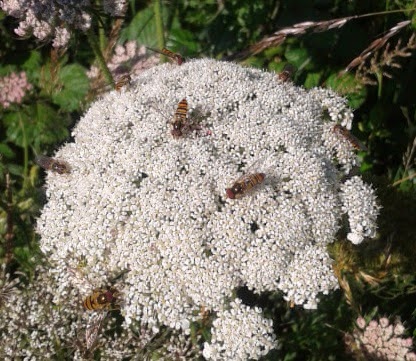

But not all made it out alive.  Misumenia vatia, the Common Crab Spider (or White Death) laid in wait.


On an Apple tree in Barleycrates Lane I came across these large unidentified moth eggs, possibly of one of the larger species such as Oak Eggar.


But, also on the same tree was this fantastic Chinese Character caterpillar, the first of these I've seen.


Later, a walk at Tout Quarry produced this unidentified caterpillar on Viper's-bugloss.  These green caterpillars could be any number of things!


On Friday night, I joined a few members of the Dorset Moth Group in moth trapping at the wonderful Morden Bog reserve near Wareham.  I'd never been there before, and I have to say it looked really nice, most like my beloved Thursley Common back in Surrey.

We set up seven traps, although it wasn't easy getting to them on the bog with no wellies! Once started we were soon seeing quality moths coming in.  The first of an incredible six lifers was this well-named Beautiful Brocade.


And I netted the scarce micro, Biselachista albidella.

At least two Rosy Wave were about, another rare species.


I potted a Highflyer sp., which I wrongly assumed to be a May.  The next morning it was confirmed as the new for me, Ruddy Highflyer.  Also at this time, the ultra-rare Dingy Mocha was found in a trap, just before I had to leave.

There was even plenty of quality amongst the species that weren't lifers, with the likes of Plain Wave, Dotted Border Wave, Silver Hook, and this worn Purple-bordered Gold.


But, about halfway through the night, I netted a moth by one of the traps that looked promising for the species that had brought us here in the first place.

Indeed it was, a fabulous Reed Leopard, which only occurs here and at one or two sites in Norfolk.  A second was later found in a trap.  Phwoar, look at that abdomen!


I fell asleep in my car to the sound of churring Nightjar.

On Saturday evening, I did my usual Little Tern wardening shift. 

They continued to be harassed by a male Kestrel, but the hard work of the entire wardening team have meant a minimum of 30 fledglings as I write, still with 30 odd chicks to go.

Unlike with my other stints, this evening I spent most of the time down by the shoreline, where I got amazing views of all the action.


And finally, whenever you're down there, keep an eye out for the rare Siamese twins!


I did another mothing event yesterday morning, as I took a look through the traps at Lankham Bottom Butterfly Conservation reserve.  Not a great deal to shout about, but the likes of Shark, Reddish Light Arches, Ghost Moth, and Plain Golden Y (a lifer) were notable.

I'm determined to get out early birding soon.  Will I be able to tear myself away from my bed tomorrow?

Sunday, 4 August 2013

Black (neck) and White (death)

The last few days have been rather uneventful.  All I can really report on the bird front is the occasional Balearic Shearwater still off the Bill, plus a Whimbrel past yesterday, and a trickle of hirundines and Swifts moving south overhead.  Some of these are also starting to gather on fences before the big push.


The weedy field right next to these Swallows (in the Top Fields towards Southwell), was alive with House Sparrows, Meadow Pipits, Linnets, Greenfinches, and Goldfinches.  A delightfully large proportion of which (as well as the Swallows) were juveniles.  This area will certainly repay further scrutinisation (made up word?!) come the autumn proper.
 
Really, the last few days have been about the butterflies.  A couple of days ago, I nipped out to Blacknor Point to do my Big Butterfly Count (read about this important survey here: http://www.bigbutterflycount.org/ ).  A 15 minute walk later and I was so mesmerised with the numbers I'd seen, I had to estimate!  The highlights were loads of Chalkhill Blue (estimate: 25), at least 5 male Oak Eggar moths in flight, and an egg-laying Grayling on the precarious cliff-edge!
 
 
Earlier on at the Bill, I had also seen this fresh second-generation Wall.


Today, I decided to take an off-island excursion to the Butterfly Conservation reserve of Alners Gorse.  The place is very much in the middle of nowhere, but it's a little gem.  The open areas are carpeted with plants I would consider scarce, such as Dyer's Greenweed, Sneezewort, Devil's-bit Scabious, Saw-wort, and Burnet-saxifrage.  Unsurprisingly, the Lepidoptera is also excellent. 


They were having an open day with walks and moth trap opening.  Well, that was the first port of call for me!
 
I helped out with emptying the 5 traps, which took 3 hours! Heaven!  We didn't total them up at the time, but I'm expecting over 100 species, on what was not the best of nights weather-wise.  The only macros that were lifers for me, were a couple of Blackneck, and a presumed Small Wainscot.


Also among the highlights were at least 15 Double Kidney.


The stunning Blood-vein.


And a Mocha, which is pretty scarce, though I have seen several before in Surrey.

 
While I was busy up to my neck in July Highflyers and Agriphila selasella, one of the butterfly walks went off to look for the reserves Hairstreaks.  Four of the UKs five species occur here, with all but one (Green) flying now.  The weather all day was pretty hopeless quite frankly, with strong winds and barely a hint of sunshine.  Despite this, the first group came back with sightings of all the Hairstreaks, including one bloke who had managed to photograph all three together! Amazing!
 
 
After I'd finished with the traps, I went off on my own into the best area for the Hairstreaks.  I soon found a lovely spot, with some Bramble flowers blooming, that had several Silver-washed Fritillaries, plus a single Purple Hairstreak, though sadly, it was completely uncooperative when it came to photos.
 
 
I also found this pretty micro, Ancylis badiana.
 

I then came across a couple peering up into a bush. They said they had a Hairstreak, though they weren't sure which one.  It took some finding, but I eventually found the rascal, and ID'd it as a White-letter Hairstreak.  I sat and watched it for ages, but sadly, apart from having a wander up and down the twig, it would not fly into a more viewable position.  The drizzle by this point didn't help!

Once I got back, they were ready to do the second guided walk, and they ended up doing a very similar route to the one I'd just done, without the Hairstreaks!  The group did eventually see a Purple, though no Browns sadly, which was the one I was most hoping for, having only had a very poor view of one before at Pulborough Brooks.  We did find some interesting Bush-crickets, including an immature female Long-winged Conehead and Dark Bush-cricket.

The other interesting observation we made was first a Ringlet...


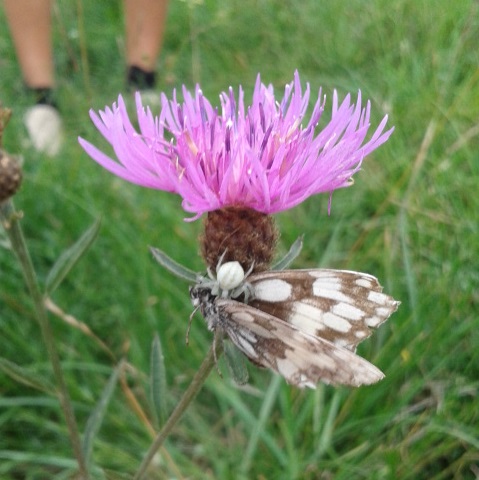
...then a Marbled White, both in the grasp of the crab spider Misumena vatia, sometimes known as White Death!


Meanwhile, back on Portland, I'm hopeful that the continuing strong-ish south-westerlies will bring one of the more unusual Shearwaters our way tomorrow.  Just one will do!