The Portland Naturalist

The Portland Naturalist
Showing posts with label Gannet. Show all posts

Wednesday, 29 October 2014

Branting and Vismigging

No wildly special sightings to report on in the last 9 days, just solid autumn birding.

Ferrybridge has been decent, with one day producing a fly-through Merlin, plus two Great Northern Diver which headed off over Portland Harbour.

The Black Brant has also returned with over a thousand Brents.


There are a number of summer migrants still hanging on with a Garden Warbler associating with a loose group of Blackcap at Suckthumb Quarry on one day, and a House Martin over the windmills on another, both my latest ever.

A Lesser Whitethroat next to the former Weston craft centre a few days ago had a brownish nape, and was therefore probably one of the eastern subspecies.

A few Swallow are still passing through (including a bird with entirely pale flight-feathers, similar to the effect you sometimes see in Crows), and Sandwich Tern are still around of course.


A bit of a blow on a few days increased hopes of some storm-driven birds, but a bit of seawatching has so far only produced a single immature Pomarine Skua, and a moribund juvenile Gannet.  I first saw this bird with its bill tucked away, and it took a while for me to realise what it was.  It looked very odd!

 
Chesil Cove was as atmospheric as ever though.


The Yellow-browed Warbler has remained at the Avalanche Rd hump throughout, but I've rarely seen it.  Just a few calls. 

I did however find a new bird at the top of Tilleycombe associating with a large roving mixed flock of birds that also included a very pale Chiffchaff.  A closer look at it yesterday revealed it not to be a classic Siberian, so probably of another eastern cline.

There are a decent number of typical autumn migrants around, such as Grey Wagtail.


Yesterday was particularly good for migration, with clear skies producing some nice visible migration (vismig) overhead.  This included a southerly movement of Woodpigeon totalling 900 birds in an hour, the largest flock of 200 birds.


Also yesterday, I found at least 3 Firecrest and 2 calling Water Rail at Verne Common, and witnessed a Peregrine continually stooping on a Kestrel.  These two really don't get on round here, as they nest close to each other on the cliffs.

An amusing observation was witnessing a Robin washing by rubbing itself on dew-covered leaves.  Not seen that behaviour before!

Definitely a feeling about the place at the moment that the potential for autumn rarities is largely over. But, you never know I suppose!

Friday, 25 April 2014

Living in a Wader Wonderland

Only five days to update, but in truth, they have been action packed!  Things are really kicking off!
 
20th
 
I started with my usual walk round the usual mid-island sites, only to find a smattering of Wheatear and a single Redstart.  However, in the bushes by Reap Lane barns was a singing Sedge Warbler, a year tick.


Come the evening, I thought it might be worth a seawatch, as the middle of the day had seen a rich vein of passage past the Bill.  I managed a single Whimbrel sat on the beach, and a nice close Arcitc Skua, but virtually nothing else in an hour, so I gave up.
 
21st
 
With forecast south-easterlies, the only option for me was attempt a marathon seawatching session in Chesil Cove.  I managed only 2.45 hours, as things weren't quite as busy as hoped.  Nonetheless, there was some top sightings, including 3 Little Gull, singles of Great Skua, Red-throated Diver, Whimbrel, and Bar-tailed Godwit, as well as a Grey Seal keeping an eye on me.
 
 
Another reason I had given up, was that there appeared to be a bit of overhead passage occurring.  On arrival at the West Cliffs, I was being watched from the top of my block of flats.  Yes, it's another Kestrel photo, but I just can't get enough of these confiding birds!
 
 
I settled down for a bit of vismig, and as soon as I started, 3 Whimbrel flew over low west.  More than I'd seen in far longer at the Cove!  My first at this site.
 
Counting was extremely difficult due to the vast front the birds were taking, as well as the rate.  A good number of Wagtail were going over, some briefly landing in the ploughed field, before continuing their journey.  These included my first british Blue-headed Wagtail, which spent 5 minutes there in the company of 2 White and 2 normal Yellow Wagtail, before too heading off north.
 
After an hour, I just managed to break the 300 mark with Swallow, not the best passage I'd experienced.
 
A little stroll to Blacknor produced newly hatched St Marks Fly, which fill the air at this time of year, so named cause they fly around St. Mark's day (April 25th).  They're distinctive for leaving their legs dangling in flight.
 
 
After lunch, I thought I'd have another go at counting the hirundines.  But, after half an hour, I gave up, not because there wasn't anything happening, but quite the opposite!  The rate of passage was far too great for me to count, as they arrived from all directions.  I got to around 370 Swallow and 130 House Martin in the 30 minutes.  I hate to think how many birds were involved in total!
 
A great day, not in the least bit ruined by missing a Northern Harrier narrowly!
 
22nd
 
I didn't get any Portland birding in today at all, as I was working in Bridport.  That didn't stop me finding good birds though, as I heard my earliest ever singing Wood Warbler on the slopes of Allington Hill, as I delivered below it.  Can't be too frequent in that area.
 

23rd
 
A medium-strength south-south-easterly meant that seawatching was again on the cards. 
 
Although there was again long periods of inactivity, my persistence paid off, and a total of 6 and a half hours put in throughout the day produced a nice list of sightings.  Best of these was a fantastic Pomarine Skua, which passed at mid-distance.  Always a thrill to see.
 
Also among the Skua were 1 Arctic and 4 Great, like this one.  Typical of the sort of view you get through the scope.
 
 
The weather was doing all sorts of things as I sat there, including quite spectacular fronts...


...and towering cumulonimbus, largely centred on Weymouth!
 
 
Also among the top records were 33 Bar-tailed Godwit, and 65 Whimbrel, 40 of which came in-off the sea together, before disappearing into the murk.
 
The most thrilling moments though came later. 
 
After an almost complete absence, a flock of some 170 'Commic' Tern suddenly appeared from the west, many of which then came inshore to feed.  Seeing a flock that size was awesome enough, but to then have them all react to a (unseen) passing Skua by towering up into the sky was quite spectacular!
 
There are always Peregrine around Chesil Cove, so I almost didn't bother to watch a bird as it whizzed through my view, but I'm glad I did, as it was actually chasing a Kestrel, which was then seen to drop something to the beach below.  A Vole!  The Falcon then descended to pick up the morsel, before finding a safe place up the beach to tuck in.  I've never seen or heard of a Peregrine robbing another bird like that.  It was at this point I noticed it was not a normal Peregrine, but a small bird with quite a dark chest, and pale-brown back.  I've scoured the books, but I still have no idea what it is!  Some sort of escaped falconers hybrid possibly.  It had no jesses (the 'dangly bits' in the shot are all from the branch it's sitting on).
 
 
Whilst creeping along the beach to get this shot, I came across my first Jurassic coast fossil!  Some sort of spiral shell.
 
 
In between my seawatching stints, I took a short walk round the island, finding only a Redstart, and a nice Whinchat.  This shot is typical of Portland.  Migrants in odd places!
 
 
Yesterday
 
Mist is always something which raises my hopes of migrant falls, and this morning was full of it.


Sadly though, it was not full of birds!  My first circuit of the usual places produced very little.  That was until I returned to Barleycrates Lane, only to find a Short-eared Owl perched on the hedge!  Sadly, as is often the case here, it was quickly flushed by a dog walker, and flew off north, disappearing majestically into the mist.
 
The only other notable event of the day was witnessing this from my flat window.


Someone had collapsed on the coast path.  Not sure of the outcome, but I suspect it wasn't good, sadly.
 
Today
 
My first look at the mid-island triangle this morning was extremely disappointing, with almost nothing of note. 
 
Luckily, I then made the decision to look at Ferrybridge and the sea from Chesil Beach, despite a northerly wind.
 
Not much on arrival at the mudflats but my first Sanderling of the year.  But then, I suddenly noticed a quite leggy small wader, which appeared quite pale.  It took me a while before I twigged it was a Curlew Sandpiper, almost in full winter-plumage.  I was expected one of these to be gloriously orange!  Not complaining though, a great bird.
 
I was also surprised to see the Little Ringed Plover from the day before still about, and showing remarkably well.
 
 
I decided then to take a look at the sea.  It was immediately clear, that there was quite a large movement of Gannet occurring, with a total of 134 past in 45 minutes.
 
 
Also seen was a nice loose group of 7 Manx Shearwater, as well as two Arctic Skua south.  It is a bit strange seeing these birds flying over a completely calm sea! 


The best was yet to come, as a very alarmed sounding Whimbrel alerted me to these two incoming Arcitc Skua, which decided on the short-cut route!


Back at the mudflats, and it was all happening.  A few small flocks of Bar-tailed Godwit and Whimbrel going over culminated in a nice record.  I heard the calls of Whimbrel, Curlew, and Greenshank, only to find a group of c16 medium-sized waders, with two larger ones, and a single long-slim one with dark wings heading off high over Portland Harbour!  If they hadn't been calling, I wouldn't have had much clue!

The morning was complete with better views of a nice mix of small waders (though not the Curlew Sand sadly!).


That's 10 species of a wader in a day.  Brilliant going for a place with no freshwater and only a tiny bit of saltmarsh/mudflats!

Later, a quick break from work had me taking a quick peak at Reap Lane, only to find the hoped for Lesser Whitethroat. 

Surely Swift will be the next to fall!

It's hotting up, but I will have to take a break from Portland birding for the next four days, as I'm back at my beloved Tice's Meadow for the weekend, then working in dreaded Bridport again Monday and Tuesday! Sigh.

Sunday, 27 October 2013

Leach's don't suck

A lot to catch up with, as my lack of photo-taking has put me off putting together a post earlier.

18th:

Today I was 'in transit' in Surrey after my Norfolk trip, and I did a recee for my leading of a walk round Tice's Meadow for the Guildford RSPB group the next day.

The place was looking quite a mess, thanks to ground works to divert the River Blackwater creating a scar through the site, plus the electricity company had felled a load of trees and branches under their cables, and just left them. 

Nonetheless, it was nice to see the local Peregrine come in with a kill of a Starling, which may well have occurred there and then, but I happened to miss it!  The birds in the workings had been unsettled for quite a while before.

 
The other highlight was at least 2 Yellow-legged Gull in amongst 70 or so Lesser Black-backed Gull.  A walk to Tongham GP added a calling Kingfisher and a flock of Fieldfare.

19th:

The walk proper went really rather well, with no rain till we were back at the cars!  There had been no real action, until not one, but two Peregrine came in and sat on the islands.  One even had a bath, and was a great hit amongst the punters (of which there were 25 or so - a good turnout)!

No Yellow-legs this time, but a couple of Snipe, and fly-over Siskin and Redpoll put in appearances.

Everyone seemed to enjoy the walk, and were delighted to be introduced to a site many had never visited before.

On the way back to Dorset, I thought it was a good opportunity to try for the current 'big thing' in the rarity world, down at Sandy Point, Hayling Island (okay, so it wasn't quite on route!).

On arrival at the seafront, the Semipalmated Plover was roosting with a flock of Ringed Plover and Sanderling, with a large group of birders in attendance.  I struggled to find a space to view, and as I got on the bird, the flock took flight!  They whizzed off towards Black Point, so I headed round there.

I kept a vigil on the best wader roosting area for some time along with a few others, but the bird was not re-found.  A shame, and I don't think I'm going to get an opportunity to go back.  That is unless I go through with my plan to start national (but strictly mainland) twitching!  I'll need to get rid of my gas-guzzler of a van first though!

20th:

After work, I thought it might be worth popping down to the Bill, as there was a bit of a south-west hooly blowing up.

As is often the case with seawatching, I saw something good on arrival, a Great Skua, before the rest of the time produced next to nothing!  Luckily, right at the end I managed the Portland tick of a Little Gull heading east, closely followed by a Red-throated Diver.

On the Obelisk I found a curious Silver-fish (sometimes called a Bristletail) Petrobius maritimus.

 
21st:
 
I took a bit of a lazy option today, and just did a short walk around the Blacknor/Bower's Quarry area in the afternoon.  A few Black Redstart had been reported from around the island in the morning, so it wasn't a surprise when I stumbled on a calling female amongst a load of boulders on the coast path.  Always a great bird to find.
 
23rd:


I again did the walk round Blacknor, but this time ventured as far as Tout Quarry, and managed to look down into Chesil Cove, that had had a Storm-petrel earlier in the day.

The Cove was virtually empty, bar a distant feeding flock of 80 Mediterranean Gull, and it was great to have a female Merlin whizz by, heading on south along the cliffs.

Blacknor Point was chat heaven today, with now 2 Black Redstart, along with a couple of Wheatear, and at least 6 Stonechat.  Clearly there'd been an influx of these too.

26th:

Chesil Cove was again the destination this afternoon, what with the weather as it is.  I first tried watching from the top of the West Weares, but saw virtually nothing.  That is apart from the Great Skua which flew right over my head being mobbed by Gulls!  The rather reddish-brown body indicated a juvenile.

Watching from within the Cove itself made things easier, but all I got was a higher count of Gannet than before!  Right at the end, a juvenile Little Gull struggled south.  On the walk, a couple of Wheatear really looked miserable as they got blown around by the wind.


Today:

Today was the day when the storm really began to make it's presence felt, hence, seawatching was again the only option.

I made sure I was in position at the Bill at dawn, in preparation for a spectacle.  A couple of Great Skua (one of which was chasing GBB Gulls), and a single immature Pomarine Skua raised my hopes.  But, other than a trickle of Kittiwakes, Auks, and Gannets, nothing else was seen!  Also a Wheatear that was attempting to feed by the Obelisk, despite having the flushing public and the strong wind to contend with!

Imagine my frustration when I later learned of a Leach's Petrel that was briefly present with this feeding flock of mostly Gannet, numbering about 120 at it's height.


I really wanted to try something else, so I imagined the East Weares would be nice, calm and sheltered, so headed there. 

Well, somehow the westerly even gusted through here, but I did see my quarry, earlier found by Keith Pritchard.  Two fabulous Ring Ouzel were feeding on Cotoneaster berries on the cliff-face, the juvenile of which was ringed.  My latest ever.  Funny how I've now seen the first, and (possibly) last RO's of the autumn, but none in between (exactly 2 months apart)!


After lunch, I headed out to my favoured spot on the West Weares looking down into Chesil Cove, as the wind increased yet further.

On arrival, I found a Leach's Petrel struggling along close inshore (though bear in mind I wasn't actually that close to the shoreline).  Perhaps the bird that had passed Abbotsbury 2 hours earlier.  That may not sound correct, but the poor thing really was pondering along.

 
As always with this sought-after species, it was great to watch, but not easy to get any footage in the wind!
 
 
I didn't really have any further opportunity to scrutinise the Cove, as soon after, it started belting down!  I had no shelter whatsoever, but had no option but to leg it home.  I had to walk against the wind, and in truly horizontal rain.
 
I was completely soaked through by the time I got home, but pretty happy with the days birding nonetheless!
 
I really can't imagine what tomorrow will bring with the winds set to strengthen.  Sadly, I'm working the morning, so I'll probably miss it all!

Sunday, 18 August 2013

The Barley Bassanus

Before I get into today, here is the Balearic video from yesterday, hopefully reproduced a lot better (watch it in full-screen):


I headed out first thing this morning, not in any particular hope of anything.  I went on down the Bill, seeing little but a few Wheatear.

Seawatching could have been an option after yesterday, but the wind had weakened, and swung round to the west.  Nevertheless, I thought the best use of my time was to join the others watching from the Obs.  Not like me I know, but it did actually pay off.  Not on the sea mind, where only a trickle of Manx and Balearic Shearwater could be found, but in the bushes.  A very confiding female Pied Flycatcher allowed everyone to photograph it, as it kept coming back to a particularly exposed and well-lit perch.


A short video of it.


I had seen the scarce Fly Tachina grossa a few weeks back at the High Angle Battery, though only ID'd it some days later.  Today, I had the chance to photograph this monster, as two were trapped in the Obs lounge.  This is the largest of the Tachinid flies, and like all members of it's genus, lays it's eggs on caterpillars (I think you can guess the rest).  This species targets Oak Eggar and Fox Moth larvae.
 
 
In the late morning, early afternoon time, I went out on a walk with my Mum and Step-dad, to show them the sights.  The wildlife highlight was yet more Clouded Yellow, and finally I was able to photo one (including a rare view of it's upperwing!).


On the East Cliffs near Cheyne Weares, we found this rather beautiful mineral encrustation on a cliff face, something I'd not noticed previously.


And a walk around Church Ope Cove produced this Portland plant tick of Common Calamint.

 
We were just getting back to the flat along Barleycrates Lane, when I noticed a white flapping thing in the corner of my eye.  All I initially saw was a large white bird with black wing-tips, floundering about in the barley field.  My first reaction was a Snow Goose or some kind of Feral Goose (they're kept up the road).  But, it soon became apparent that it was actually an adult Gannet!
 
I called the Obs.  No answer.  What to do?  I had to go and tackle the thing myself. 
 
So, I went traipsing through this field (probably trespassing) with a blanket.  It was amazingly difficult to locate at first, but once found, it was fairly easy to capture.  It growled at me as they do, but I just threw the blanket over it's head, and quickly grabbed it's beak!  Although unsuccessfully at first, as it grabbed my finger through the blanket!  I did manage to subdue it in the end, and carried it under one arm back to the car park. 
 
My Mum and Step-dad kindly drove me to the Obs.  If they hadn't been there I'm not sure what I would've done.  Quite possibly chucked the thing into the back of my camper and driven (carefully) down there!
 
Once at the Obs, it became apparent that Martin the warden was out for the afternoon!  Myself and the visiting ringer put it into a small metal cage, and it seemed quite happy.  It had no obvious injuries.  The ringer consulted the books, and reckons the bird is a 5 year-old female.  I waited patiently in the hope that Martin would get back soon and be able to release it that afternoon.  Sadly not, but hopefully, all being well, it will be released tomorrow morning.  How it came to be in the barley field remains a mystery.


Now excuse me while I have a bath, to rid myself of all the Lice which decamped from the bird, when they decided I would make an excellent new home!

Friday, 12 July 2013

Auksome!

Another day off today (the benefit of working part-time), and the sky was lovely and cloudy, so I thought I'd go down to the Bill first thing to look for migrants, and then do some seawatching.  Well, a quick look at Avalanche Road, Top Fields, and Culverwell produced absolutely nothing of note.  Except, in Culverwell I found a tree full of juveniles.  At one point, there were young Linnet, Greenfinch, Great Tit, and Goldfinch, and shortly after some Blue Tits and a Dunnock visited it too!  Must be the day-nursery tree.  A plant lifer here was Brookweed.


Onto the Bill then where I was greeted with little to suggest a decent days passage.  However, within five minutes of me sitting down, a Curlew, a Common Tern, and 7 Manx Shearwater went past, raising my hopes.  But, the next 25 minutes went past totally uneventfully.  That was until 7 on the dot, when I couldn't help noticing a summer-plumaged Black Guillemot passing east close-in with a small flock of Razorbill and Guillemot, sticking out like a sore thumb!  There were several sightings of a bird offshore during the winter, so this is presumably the same individual that has lingered, who knows where!  You would have thought someone would have noticed if it had been in amongst the Bill Auk colony!  That was not the end of the quality, as not so long after that, a Balearic Shearwater passed east at mid-distance.  Also seen was another 7 Manxies and a lingering Mediterranean Gull.

Frustrated that I had not yet got any seabird photos, I spent the next half-hour or so experimenting with phonescoping Gannets!  Not easy!


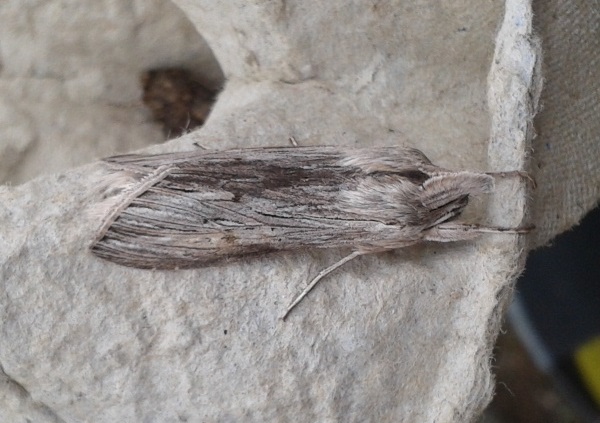
Next I had a quick look in the obs moth trap.  It was heaving with quality as usual.  The best was this lifer of The Shark.


Amongst the other quality was a Lackey (a species I rarely see as an adult).


This Muslin Footman, which I have only seen previously in Wales.


And a Cochylis hybridella.


On the way slowly home for lunch, I decided to pop into Cheyne Weares, for no particular reason really.  As I arrived, I could hear the small birds calling wildly, and looking off the cliff, a cloud of Pipits and Linnets appeared, surrounding a juvenile Cuckoo!  The first time I've seen this plumage.  It flew off and landed out of view in a tree by Avalanche Road.  I'm certain it was a migrant, and not a locally-bred bird.
 
I continued to walk along the cliffs, and stumbled on the Portland plant ticks of Ploughman's Spikenard, Small Scabious, and Golden-rod (below).


The sun was now out with all it's force once again, and I took the route home that took me past Suckthumb Quarry, and onto Weston St.  On this area of grassland, I found this mating pair of Crescent Plume moths (notice that the leaves of Restharrow - their foodplant - are in the background).

 
And this is not something you just come across everyday!  A female Drinker with her eggs.


This was all just the morning remember!  Portland is a magical place.
 
In the afternoon I thought it might be worth holding a vigil at Ferrybridge, as you never know what might drop in.  The problem with this site (particularly on a day like this), is there is always another moron happy to ignore the nature reserve signs.  Nevertheless, I managed to count 53 Mediterranean Gull in attendance.
 
 
And I was entertained by watching this Great Black-backed Gull trying to devour a gigantic (already dead) Spider Crab.
 
 
Once the tide had gone fully out a nice sandy island, where no human can tread, had appeared.  On this I found 3 Dunlin, a Grey Heron, and 3 Sandwich Tern, including an early juvenile, begging for food as usual.  Are there are any colonies closer than Brownsea?
 
I had to walk along Chesil for a little way in order to see the aforementioned sandbank, and as I did so, I found a botanic gem.  It may not look much, but this Four-leaved Allseed is pretty rare (the green one, the red one is a Stonecrop).


What wonders await tomorrow.