The Portland Naturalist

The Portland Naturalist
Showing posts with label Lulworth Skipper. Show all posts

Tuesday, 10 June 2014

Italy Trip - Days 1 + 2

31st May

I wasn't totally sure what I was expecting from Italy, particularly in regards to the wildlife.  I suppose I was not expecting much to be honest, particularly as it's rarely mentioned as a destination for a wildlife holiday.  On top of that this was a family holiday, and I was doubtful that I was going to get much opportunity to get out to the best wildlife sites.

We (myself, my brother, mother and step-father) touched down in Rome late-morning, and immediately I was on the lookout for birds from the car, as we made the 2 hour journey south to the town of Formia.

Zitting Cisticola could be heard singing from any small patch of grass by the roadside, and plenty of Hooded Crow and a Black Kite was spotted.  Lots of Sparrows were heard and glimpsed, which of course were going to be Italian Sparrow, so the first lifer (depending on which authority you listen to of course!).

We stopped briefly near our rented villa by a flower-rich verge.  Straight away, quality was found with a Spotted Clover day-flying moth, and of course the Carpenter Bee Xylocops violacea.  Despite their abundance throughout the week, this was the best shot I managed!


As we pulled up to the house, I spotted something bold flitting about an Oleander bush.  As soon as I could, I headed out there to take a look.  It was soon found, and it was the stunning moth Nine-spotted.  There are a couple of similar species, but I think the wide yellow band on the abdomen suggests it to be the commoner, Amata phegea.


I went on to see plenty more throughout the week, particularly in our garden.  Talking of it, this was the view from our garden, across to the town of Gaeta.


Besides the Nine-spotted, there was plenty of stuff to be found here.  It was full of Olive trees and various flowers, including these commanding Cacti.


Even more dynamically, there were plenty of butterflies flitting about, including the Cleopatra.  Although at rest they closely resemble Brimstone, in flight they are unmistakable with bright red patches in the centre of the upperwing.


Along with Wall Brown, they proved to be commonest butterflies throughout the week.

There were a few birds around too, with a Sardinian Warbler singing in next-doors overgrown garden.  Also a few Serin, and the ubiquitous Swift, which is probably the commonest bird here.  I was desperately scanning the flocks in the hope of Pallid, which are in this region.  Instead I found an Alpine Swift cruising overhead, dwarfing the commons.

A Peregrine was a fitting end to the day, steeling in and scattering the vast Swift and hirundine flock.

In the local supermarket, some drinks companies know exactly how to win my favour.


1st June

Last night, I left the outside lights on in the hoping of attracting one or two moths.

It worked, with a decent selection sitting on the wall. 

One or two Geranium Wave Idaea eugeniata,


plenty of the Bee Moth-like Lamoria anella,
 

a few Lustrous Least Carpet Idaea filicata,


a single Least Black Arches relative, Nola chlamitulalis,


an unidentified Bee Moth-like individual, possibly a female Lamoria anella,


and lots of Rush Veneer.


Incidentally, the number of migrant moths (from a UK perspective) like the latter, was very great.  How many of these were locally-bred, and how many had come from Africa, I'm not sure.  Some more of those later.

Other than that start, there was little wildlife watching for the rest of the morning as we had a walk round the town.  The conditions were already scorching hot.

I did find this Weasel's-snout, a rare plant in the UK.


As well as this familiar Lulworth Skipper.


In the afternoon, we went somewhere right up my street, the country park of Parco di Gianola.

The woodland there was impressive.


And carpeting it was plenty of Ivy Broomrape.


There were a few more interesting butterflies at this site, such as familiar Swallowtail, and less familiar Mallow Skipper, and Ilex Hairstreak.

I also found this stunning large caterpillar feeding on Broom, which turned out to be the larva of the rather dull noctuid, Apopestes spectrum.


There was a good view from the end of the head.


The grassland here was alive with interesting insects, such as this bold Crambid moth Angustalius malacellus.


And this pretty Flower Scarab Oxythyrea funesta.


Plus, there were lots of Burnet Moths of at least two species present.  The Transparent Burnet (of the nominate subspecies, not as 'transparent' as the British subspecies) was far the commoner.


One of the most obvious creatures here, and indeed in much of the rocky and even urban areas around the place, was the Wall Lizard.  The sound of them scuttling for cover from the edge of paths was an almost constant accompaniment to our walks.


There were a number of Roman ruins at this site, though the amount of mosaic remaining was rather pitiful.


We found ourselves in a tiny Roman harbour, and this turned out to be a good place for rock pooling.  There were lots of Sea Anemone, which looked their most stunning out of water.

 
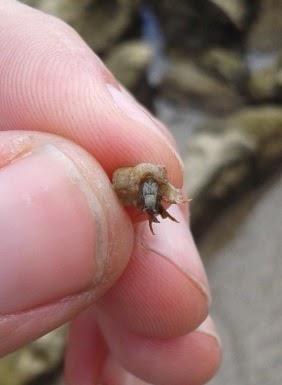
 Plus, I somehow spotted this minute Hermit Crab scurrying amongst the silt.


The route back through the woodland took us past a colony of Alabonia geoffrella. A species I've noted in the UK and France in the past.


Before we made it home, we went up the road to a holy shrine, which happened to be in a cave.  The place was full of Bloxworth Snout. 


In the evening I again put on the outside lights, and held a vigil by them for a while.

To my surprise, I spotted a number of Firefly flitting about the place, flashing their bioluminescent final segment to their body.  I had no idea we had them in Europe.  Turns out they are closely related to our Glow-worm.


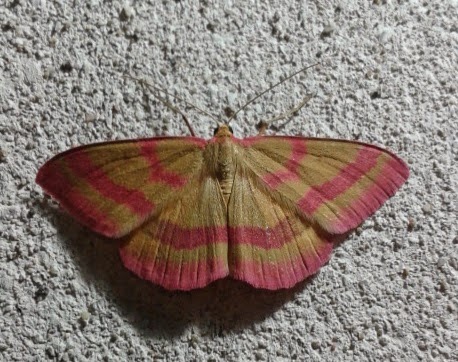
A moth did eventually show up, and it was worth waiting for.  The stunning Narrow Rose-banded Wave Rhodostrophia calabra.


A promising start to the trip!

Monday, 22 July 2013

Fog it!

Last night, we were treated to the most amazing thunder and lightning show, as the first rain fell for several weeks.  It wasn't a great deal, but boy does the grass need it.  The day then started like any other day in terms of weather, but, as I set out down to the Bill after work, an extraordinary sea fog rolled in.  That was seawatching stuffed.  What to do then?

Well, first I had a look at the moth highlights from last night.  The best was Fen Wainscot, which I haven't seen since I first used a moth trap, in Yorkshire in 2006.  A pretty bland species though!

 
The other top moth was the much more patterned Campion.


I decided that the only course of action was a walk around top fields, in the hope of any migrants.  A view of the Obs (can you spot it?) from the top of Culverwell.
 
 
At the top, there was a good number of hirundines flying about, including about 30 Sand Martin and 10 House Martin.  Apart from that, my entire walk, which included going past the Southwell Business Park, produced no other birds of interest at all.  So, it was up to the butterflies, which were still active in the moist conditions, to entertain.  I found the most patterned Lulworth Skipper yet (presumably a female?).


My first Small Copper of the year was found.


Add to that the likes of Comma, Peacock, Marbled White, Large Skipper etc, but I also found this Knot-grass moth larvae munching away at an Agrimony plant (notice the remains of it's last moult below).
 

And I also found this wacky Weevil.  Wish I knew the species.


It's still foggy as I write, and apparently, we are in for a downpour tonight.  Excellent.


Tuesday, 16 July 2013

On the (Cross)bill

For the rest of the week, I shall be working in Weymouth.  A bit of a pain in terms of travelling (I'm attempting to cycle it - exhausting doing Fortuneswell hill!), but it means that I may be able to visit Ferrybridge and the Weymouth RSPB reserves on the way there and back, depending on the time. 

Today, I stopped off at Ferrybridge first, where I bumped into Pete Saunders, the Portland photographer general!  He hadn't seen much, and neither did I, apart from a few Mediterranean Gull and 6 Dunlin.  Then, as I was continuing my journey just over the bridge itself, a single Sanderling flew over the road, towards the mudflats.

On arrival in Weymouth I noticed I still had plenty of time, so I decided to do the quick Radipole trail, up to the Buddleiha Loop and back.  No sign of the Hooded Merganser (isn't it time it was given a name?), but no doubt it was still around somewhere.  This juvenile Reed Warbler showed well (phone-bined shot!).

 
I continued round the Buddleiha Loop, stopping to get brilliant views of a couple of juvenile Bearded Tits which were feeding in the reeds right next to the path.  I attempted to get a shot of them, but failed miserably!  Not quite in the same league I realise, but this rather scruffy Coot was more confiding (only the best for this blog ;-).
 
 
At the viewpoint, I failed to find the Red-crested Pochard of recently (though I didn't have the time nor the optics to do a proper search, so it could well still be about), but did see a Common Sandpiper and a few normal Pochard.  I hadn't been here for a few years, and I was really impressed with the quality of the place.  Love the new viewing platforms!
 

Whilst on my round at Wyke Regis, I had the fortune to hear a small flock of Crossbill flying over south.  I couldn't locate them, but I was hoping they may have got picked up at Ferrybridge or Portland, as I assume that's where they were heading, but apparently not.
 
On the way home past Ferrybridge, I noticed a Whimbrel on the far side, attempting to avoid the holidaymakers.  There has been one reported there for several days.  The same bird? 


I couldn't help noticing the great success Joe Stockwell had with Lulworth Skippers the other day, so decided the area behind the Pulpit Inn would be my afternoon excursion. 

On the way, I made the customary flying visit to the obs moth traps.  Not a great deal notable in there (though a lot had no doubt got away since this morning), but there was a Herald, as well as the impossible to pronounce Ptocheuusa paupella.

 
Plus, I took the oppurtunity to (poorly) photograph Kent Black Arches, which appear to be pretty common here.


 The grassland of the base of Bill Hill was alive with butterflies, as you would expect on a day like this.  I initially had a little trouble locating my quarry.  But eventually I got my eye in, and I think I got used to picking out the Lulworth Skippers, mostly by their smaller size (even compared to Small/Essex).  Photographing them was a real pain, particularly due to their habit of landing amongst tall grass.  Not only is it a struggle to get into position, but you've then got the problem of grass stems causing shadows!  In the end, even my best shot had this.  Never mind, I'll settle for it.  Beautiful insects!


On the way back over the Top Fields, I found the new plant of Scented Mayweed.  They really do smell lovely!

Back to Weymouth tomorrow, and maybe a Garganey at Radipole?  Would be nice.

Saturday, 13 July 2013

I'm not Lulworthy!

I didn't have great conviction when I set out this afternoon, straight out into the inferno once again (when will it end?).  I didn't think there'd be much going on bird-wise, and there wasn't, so I decided the only course of action was some seawatching from the Bill.

First though, I had to take the regulation look at the obs moth trap.  Still absolutely packed in there, but just the one highlight really, of Britain's largest moth, Privet Hawk-moth.


Onwards to a seawatch.  The Bill was alive with tourists, as you can imagine on a Saturday like this.  I'm not sure how I avoided people asking me what I was watching (or 'haemoroids' as one of the Portland regulars calls them - they come in groups, and they're a pain in the arse!), but most of the time my answer would have been ''sea'' anyway.

The small amount of interest was provided by a flock of 20 Common Scoter, a Sandwich Tern, and 2 Mediterranean Gull, all east.  The highlight was a 2nd-summer Yellow-legged Gull, west.

I thought I'd just pop into the obs to report that stuff.  No-one was around, and I noticed on the sightings sheet, someone had written ''probable Richard's Pipit in field below coastwatch''.  As improbable as that sounded at this time of year, I had to go and check it out. I had run out of ideas as to what to do next anyway!

I stumbled about the top fields around the coastguards, finding little in the way of birds.  The field I think they meant is really in an awkward position, and can't be viewed easily, so either they walked over to it (not sure what the access situation is here), or they saw the bird by the path, and it flew over to there.  Either way, there was no sign of anything looking like a Dick's.  However, the walk did have it's compensations.  First of all, I found a good number of Narrow-bordered Five-spot Burnets with their commoner cousins.


This shot, I believe, proves it is the Narrow-bordered.


And, both the Narrow-bordered Five-spot and Six-spot together.


Some rustling in the grass, alerted me to this huge Brown Rat, which was too busy rummaging around in a hole to notice me!


 He scarpered a split second after this shot was taken though!


A brand new plant here was Lucerne.


Ever since I came onto the island, I have been double-checking every Skipper I see, and today that paid off.  My first ever Lulworth Skipper was extremely jumpy, so this was all I could manage by way of a photograph.


I saw on Twitter that Keith Pritchard (@portlandbirder) was going on his usual walk this evening along the East Weares, and was inviting anyone to join him.  So, I met up with Keith on a beautiful and still evening, and headed out onto the Weares.  The bird highlights were one of the juvenile Peregrine begging it's father for food, a few Common Scoter offshore, and a pair of Bullfinch.  Not a great deal out of the ordinary then.  However, we did have one of those 'ones that got away' moments.  We heard, deep inside a bush, a thin warbling sub-song that neither of us could recognise.  We held a vigil there for some time, but whatever it was steadfastly remained hidden.  The best way I can describe it, is the speed of a Dartford Warbler, but with the tone of Goldcrest.  Listening to a few songs on the web, the best matches appear to be Subalpine, or even better, Greenish Warbler.  Lets hope that Keith and his mate John are able to track it down tomorrow morning.  A Portland plant tick here was Vervain.


Thanks to Keith for leading me round his brilliant patch.  I urge everyone to follow his excellent blog: http://birdingportlanduk.blogspot.co.uk/