Day 3 (15/10)
This morning, I didn't have anything particularly dynamic in mind for my early excursion, so settled on a long-ish walk from Old Hunstanton north through the dunes to Holme and back, mostly following the edge of the golf course.
There were no particular species highlights, but it was great to experience good 'viz-mig' with lots of Chaffinch heading south, with smaller numbers of Brambling, Siskin, and Redpoll. Many grounded thrushes were feeding on Sea Buckthorn berries.
At the Holme end, I found a Grey Wagtail on the edge of a puddle, and I came across a garden with a load of thrushes and Brambling feeding on fallen pears.
The first scheduled stop of the day was to that staple of Norfolk birding, Titchwell. No visit to the area is complete without a good look at this place.
Good views were had of Bearded Tit on the walk down to the beach, as a small group indulged in one of their dispersal flights over our head. The only bird of real note in front of the hides was a single Little Stint, though others saw Curlew Sandpiper as well.
Once at the beach, the search was on for the famous Snow Bunting. I walked a fair way along to the right before giving up, and attempting the left direction instead. Once at Thornham Point, there was nothing for it but to go back, so I did so along the top of the dunes. As I did so, I flushed two Lapland Bunting, which flew off calling, before coming back down a distance away on the saltmarsh out of view. I got a glimpse of the orange wing-patch on one, plus recognised the call. On that same walk back I also found a Brambling feeding in the low weeds on the seaward side, much of the behaviour of the absent Snow Buntings!
In the dunes, I found a large number of the scarce Dune Waxcap fungus.
I was also able to spot a very distant Great Skua out to sea, and on the marsh was Avocet, Egyptian Goose, and Ruff. On the walk back to the centre, I came across one of the latter feeding right by the path!
This shot shows you what sort of view I had through the scope!
Before the afternoon walk, I decided to rush over to the fields just south of Wells Woods, where the Siberian Stonechat had been reported again. If it's anything like a normal Stonechat, it shouldn't be elusive! Indeed, once there, the fantastic Siberian Stonechat was immediately in view, and fairly close-by too.
I even managed to jam a shot of the diagnostic orangey rump!
I was very lucky, as it then flew off to a distant fence, where it had apparently been most of the time. My only lifer of the trip.
I was also fortunate to meet a very understanding traffic warden once back at my un-ticketed van (I paid for an hour yesterday and only stayed half-hour, as was the same today, so my conscience is clean!).
The afternoon walk was along the sea wall from Burnham Overy Staithe. We only got about halfway towards the quality dunes, but this was far enough to see our second Great Grey Shrike of the trip, as one hunted around a reedy pool, and if anything showed better than the Holme bird.
Rather than walk back the same way like everyone else, I planned to take the inland path back towards the A149, then back along the road. This turned out to be a good decision, as I had a close encounter with a covey of 4 Grey Partridge on the other side of a hedge.
On the way back to Old Hunstanton, I popped into Holme in the hope of Owls. The weather wasn't the best, and none were forthcoming. That's despite my best efforts, even climbing on the top of my van for a better panorama!
I've just come back from 5 days in Norfolk with the RSPB Guildford Group (though I largely did my own thing, as I slept in my campervan). The place never ceases to amaze, and it always produces the goods. Day 1 (13/10)
The group were scheduled to meet at Welney at midday, so I thought it logical to leave Surrey early, and go for the Two-barred Crossbills that have been delighting all-comers at Lynford Arboretum, which is only 20 miles from Welney.
The weather was pretty much awful all the way there, and as I arrived, it didn't look like it was going to change. No Crossbills at all were encountered in my first hour or so by the main entrance, and that's hardly surprising in these conditions.
A couple of Common Crossbill did eventually appear, but merely as fly-overs. I got bored eventually, so I took a little walk round. It was clear that a load of Redwing had arrived, with birds everywhere. I soon found some Marsh Tit near the car park, and I was entertained by a pair of Coal Tit chasing around, before grappling with each other on the floor. I wish I was quicker with my camera setup! Also Nuthatch and Sparrowhawk around. A nice spot.
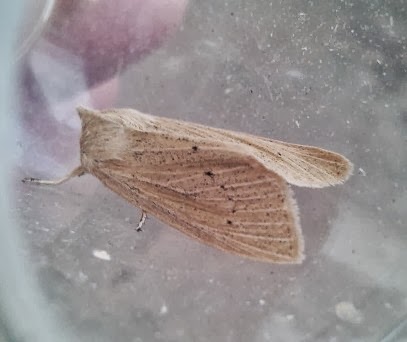
Onto Welney, and luckily the weather had improved markedly. On the way to the main observatory, I noticed an outside light with a few moths around it. There was a Sallow, plus lots of Large Wainscot.
The best though was only my second Green-brindled Crescent.
Now with the rest of the group, the observatory itself had all the expected suspects in view, and I was also able to find a rather out-of-place Rock Pipit which made a brief visit to one of the islands. A large flock of c60 waders flying around had me confused at first, till I realised they were all Ruff! Never seen so many together before. The ID was clinched by seeing a particularly pale white-headed male amongst them. A couple of Marsh Harrier showed well, and a distant flock of Golden Plover flew by.
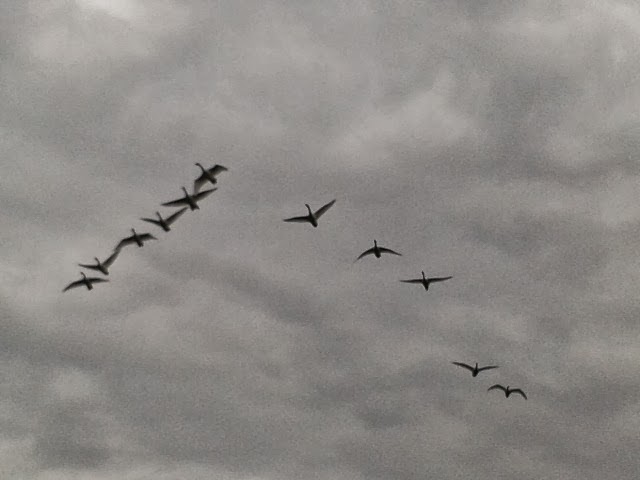
I went off to look from the other hides, but there wasn't a great deal new. Though it was great to see the herd of Whooper Swan coming in off the fields for a wash, right over my head!
In the group of 70 odd birds, there were only 4 juveniles (though not all the flock had returned yet).
On arrival at the last hide, I was greeted by the site of 2 Crane flying off and over the far bank (thanks Christine). We had earlier been told that they have been present for a while, though had not been seen today! They were obviously keeping their necks down.
The evening meeting at the group's hotel wasn't until dark, so I wound my way north, stopping at Dersingham Bog. With all the Great Grey Shrikes on the coast recently, surely one would filter through to this site? Well, a bird could have done, but the weather was in no state for me to see it! The only highlight here was seeing my first Pink-footed Goose flock of the trip pass over.
I'd never had a proper look round the site before, and have to say it feels extremely like Thursley Common (and it was equally as bleak as Thursley can be too!).
I got to the hotel car park at Old Hunstaton still with plenty of light left, but with the weather still grim. I took advantage of my van, and used it like a hide to look out onto the beach. Plenty of waders down there including Bar-tailed Godwit, Knot, and Sanderling. I was looking further out to sea when a Tern flew through my scope view, over the beach. It was clearly an immature 'Commic' Tern, and the lack of black in the wing, buoyant flight, and short bill, all pointed to it being an Arctic Tern. My latest ever, and a great end to the day.
Day 2 (14/10)
The day before, an Arctic Redpoll had been reported from Wells Woods, which is a lifer. So, I decided that this should be my morning expedition.
As I opened my van door, I could hear a Brambling calling. Then I walked round the back, and flushed a Crossbill from the hedge! I knew I was in for a good morning!
There were indeed birds everywhere. Loads of Redwing, Brambling, Crossbill, Chaffinch, Siskin, plus a few Fieldfare and Redpoll. Sadly the latter were almost all fly-overs, and I only got decent views of two birds feeding in a Birch tree, which were definitely Lessers.
I wandered along the main path, and found the newly arrived and clearly exhausted birds to be extremely approachable. Look at this Brambling for instance (using my phone camera hand held, with no zoom).
Most of my previous sightings of rarer leaf-warblers have been in tit flocks, so when I came across one near the Dell, I made sure I gave them careful attention. Lo and behold, I had no trouble finding a Pallas's Warbler. The 'Eastern Sprite' showed brilliantly, though my video (later on in the post, included with Yellow-browed Warbler) doesn't do it justice. Whilst I was watching the bird, I heard a Yellow-browed Warbler call in the distance! That's Norfolk for you.
The first group visit of the day was to the fantastic area of Holme Dunes. The plan was to look from the hides on the NWT reserve, but when we heard there was a Great Grey Shrike in the dunes to the east of the pines, we headed there.
The pines themselves were absolutely heaving with Robin and Goldcrest, which had clearly arrived overnight. I was surprised there weren't any Firecrest with them. On arrival at the dunes, the Great Grey Shrike was immediately in view, sitting on a Rose twig on the saltmarsh, and went on to perform pretty well. Although it was a shame that we apparently missed the moment it caught a small bird in the bushes!
A small flock of Eider were on the sea, and the ever present Marsh Harrier showed well as usual.
I had heard that a Bluethroat had been around the Bird Observatory yesterday and this morning, but it was apparently very elusive, so I didn't have much enthusiasm for checking it out. However, we bumped into a few people who told us it was showing more frequently, so that's where we headed next.
We hadn't been long there, when someone picked out the Bluethroat sitting on a Bramble bush the other side of the Serpentine, and I eventually got on it, though rather distant! A Robin and a Blackcap came and sat alongside it at one point. It then flew off out of view.
Later, I was able to see it again much closer as it fed in some Willow carr, but it was badly obscured by braches! It was a young male, as was confirmed by the trapping of the bird just after I left!
On the way back along the approach road, I stopped at an area of Sycamores that had held a Yellow-browed Warbler earlier in the morning. There were a lot of Goldcrest in the area once again, plus a few Chiffchaff. Eventually, I was able to find the Yellow-browed Warbler on the edge of the trees, and as the sun came and went, it showed well. Sorry, the footage is really quite appalling (first half is the Wells Pallas's Warbler)!
The final stop of the day was to Snettisham. Just as with the last two times I've been here at this time of year, the high tide was too low to force the waders off into the lagoons, which was a shame. I even took my bike along so I could effortlessly get down to the far hide, only to be greeted with Greylag Goose, and not a lot else!
However, this was more than made up by watching one of two Peregrine, chasing a Dunlin about relentlessly in Merlin-like fashion for some minutes, before eventually dispatching it with great agility and determination. Great to watch!
The other top sightings were a Great Skua which lumbered it's way along the shoreline looking for opportunities, several Avocet, my only Wheatear of the week, and a very distant Arctic Skua chasing a Sandwich Tern.
Finally, I rushed east to try and see the Wells Siberian Stonechat before dusk, only to find no sign of it. It was believed to have already gone to roost.
Sorry for the rather cheesy title, but I really struggled to come up with one for this post! 8th
The only birding I've really managed on previous days was Tuesday, which was a day off work.
I did my usual walking route zigzagging to the Obs and back via various promising spots. However, today was not promising for stuff on the ground as it had been a clear night, and the morning was completely clear too. A little was going on overhead, but there had clearly been a clear-out of things like Blackcap and Chiffchaff.
Nevertheless, the ramble started really well with a nice late Lesser Whitethroat feeding on Elderberries in the garden of the derelict house at the beginning of Barleycrates Lane, then whilst I was watching it, 3 Redwing flew out of the leylandii hedge, calling. A classic case of summer meets winter.
The rest of the walk to the Bill was largely uneventful, though watching 2 Buzzard and 3 Peregrine interacting was thrilling!
On arrival at the Obs, there were as usual some great moths to look at. The main highlights were the scarce migrants, and lifers, of a rather worn Dewick's Plusia.
But even rarer, was this Small Marbled. Here it is by a teaspoon to give you some idea of it's lack of stature!
Among the other top species was this wandering Large Wainscot.
And this fresh Brick.
Although these have been featured before, I did like this formation of fresh Mallow and Black Rustic.
As well as this striking form of the common Lunar Underwing.
Continuing the theme from my last post of spectacular things (other than moths) found around the moth traps, today this solitary waspEutanyacra pictawas hanging around. Thanks to Gavin Broad for the ID.
I decided on a slightly different route back to usual, and discovered there had been a real influx of Robin overnight, with many found, some in odd places. One small area of bushes by Cheyne Weares held three in close proximity. These bushes also held a single Goldcrest, which is my first on the island this autumn.
I wound my way home via Wakeham and Watery Lane, which held a few more Wheatear than most places, as well as a single Whinchat.
Today
The reason why I've not been out birding much lately, is solely down to working at Bridport, which means I'm not free till gone 2, which is pain. This may have affected my chances of seeing the Thrush Nightingale that was trapped yesterday, though in truth as it wasn't seen after release, I would have been very lucky to have been in a position to see it. Anyway, when I heard that a Short-toed Lark had been found this morning, I was understandably pessimistic.
I rushed straight to the Privet Hedge at the Bill this afternoon, to see a single person walking up the path the bird had been on, and no-one else around!
I sauntered up the hill, only to find at the top, that I was faced with the Short-toed Lark on the path! I rushed to get my scope out of my bag, but as I did so, it flew off, and where it flew to was unseen. Great.
Myself and this other bloke had a bit of a walk around, but there was no sign. I stayed put scanning the privet paths, while the other chap went off to search elsewhere. After a while, I looked down the hill to see another birder coming up, only to notice the bird was back on the path between us! I rushed back up to try and alert the other birder, but he was now off in the distance so it took some time (I can't wolf-whistle!).
I returned to the bird, only to find the other guy walking up the path, almost at the top! Well, apparently he hadn't seen the bird right in front of him and had flushed it! Yet again, we were stuck with no bird and not a clue of it's presence, as the Saunders' arrived. After a while I got a bit bored, and decided to get a different view from the bottom of the hill.
As I got there, I noticed a bird on the path, it was it! I don't know how it sneaked around like it did without us seeing it so many times!
Anyway, it went on to show brilliantly, and it came within metres of the observers, as you will see from my video.
Believe it or not, despite about a million being reported, I'm yet to even glimpse a Yellow-browed Warbler. It's not high on my list of priorities, but it would be pretty poor getting through the autumn without seeing one given this influx! I'll keep trying.
Perhaps I'll see one in Norfolk which I'm leaving for on Sunday for a 5 day trip. On my way via Surrey, I may be able to go for the Two-barred Crossbill that's currently being elusive there in addition. Fingers crossed!
Sorry about the length of this post, but I didn't want to post yesterday due to a lack of photos, and I've ended up with a glut of them from today!
It's rather exciting that we are now into October, and it's all going off here in Dorset, despite the lack of cripplingly rare birds (they'll come hopefully).
3rd
The only wildlife watching I did today was a cycle to the Obs and back, really to take a look at the rare moths they'd got.
I was cycling along the edge of the houses next to Barleycrates lane when I flushed a Redstart from the fence. I only got a brief glimpse as it disappeared into the bare gardens, but location would be a pointer for Black Redstart. An odd observation were one after another Wheatear on the house roofs! I've seen the odd one like that before, but not so many.
I went to the Obs principally for the rare 8th for Britain, Egyptian Bollworm, and what a beauty.
Also among the quality was the scarce migrant Antigastra catalaunalis.
Still lots of Wagtails, Wheatears, and Meadow Pipits in the Barleycrates horse fields.
5th
Today was a key day, as I visited many areas after the best birds, though I didn't manage any photos worth showing, just the one 6 second video!
First of all, off the back of work I took a walk round Verne Common. Just like other sites, it was crawling with Blackcap, Whitethroat, and Chiffchaff.
The interesting observations here though were an 'cecking' call coming from deep in cover, which I realised was an out of place Water Rail (I've now encountered 2 of these on Portland, but never seen Moorhen or Coot here!), my first 4 Siskin of the autumn over, a bit of Cormorant movement in the shape of a flock of 26 over, and finally a nice own-found Vestal.
After lunch I thought I'd better give these birds at Bridging Camp, Wyke, some time. Earlier in the week I had popped into there first thing to try and see the Shrike, but it was hiding.
This time, the nice juvenile male Red-backed Shrike proved no problem (my third of the autumn), as it sat on the boundary fence of the old derelict army camp, on arrival. The other quality bird of the site was much more elusive though. Eventually, I re-found the juvenile Red-breasted Flycatcher at the far end of the site sitting on a horse jump, and it went on to show reasonably well, though distant. It was getting a hard time from the local Robins. Blink and you'll miss it!
Only my second ever. Apparently earlier in the afternoon, the Flycatcher and the Shrike had been side by side on the same fence at one point! Welcome to birding in Dorset.
I quickly popped into Radipole on the way back, as I wanted to achieve my latest ever Hobby. They were much harder than I imagined, but one eventually showed well.
After an uneventful check of Ferrybridge, I got back on the island. I was determined to search for migrants, so embarked on a grand tour of Wakeham, Perryfields, Bottomcombe, Yeolands, Broadcroft, and Bumpers Lane. I was justly rewarded with one, then two Grasshopper Warbler at Perryfields/Bottomcombe. I flushed the first from beside the path, and the second popped up into a nearby bush and briefly sunbathed. Don't worry, I made sure they were 'just' Common Groppers! I've gone the whole autumn without seeing one (other than in-hand) and I visit a relatively poor site late in the season and find two!
Other than a load more common warblers, the only other birds of note were a single Whinchat at Grove, and two fly-over Ringed Plover at Broadcroft.
Today
The day dawned beautifully clear and still, with a bit of mist hanging about.
Unfortunately, this meant that most of the grounded birds on the island had left overnight! I got all the way to the far end of Reap Lane before I saw a Wheatear or a Blackcap! A check of Southwell School produced no eastern sprite (Yellow-browed Warbler to those English-speakers amongst you), though typically, it was seen later in the morning. There were still two Yellow Wagtail hanging on to the Pipit flock, an adult and a juvenile.
Predictably, there was a great deal of vizmig (visible migration) happening in the clear, still conditions, but the only oddities I encountered were as I was walking past Southwell Business Park. These were a Grey Wagtail, a Reed Bunting, some Siskin, and I heard my first Redwing of the autumn too.
There were a great deal of butterflies still on the wing in these positively balmy conditions, and alongside Small White, tons of Red Admirals, and Speckled Wood, were a few Clouded Yellow and Painted Lady still about. Also this late Small Copper.
As I got to the Top Fields, I immediately noticed a Short-eared Owl come right overhead being mobbed by a Kestrel. It then flew around in circles, as if making sure that everyone had noticed it's arrival. It then landed in a field close-by.
I attempted to film the Kestrel chasing it, though it looks like it had peeled off just as I started filming.
The Kestrel itself was one of many, and as usual, these birds seem to be particularly confiding here.
I eventually made it to the Obs, where a Yellow-browed Warbler again eluded me. To be fair though, I'm not putting too much effort into seeing one, as hopefully I'll bump into one soon, particularly given the number around at the moment.
The moths were excellent, and I also managed to catch up on a few goodies from previous days. The rarest being this Old World Webworm.
Among the scarce migrants were this White-speck.
And this Pearly Underwing.
As well as the rather dull Scarce Bordered Straw.
Plus a few commoner species, that were still quality, including this lifer of Dusky-lemon Sallow.
Only my second Mallow.
A common Beaded Chestnut.
And finally this scarce-for-the-site Blair's Shoulder-knot.
Last, but certainly not least, among the pots of moths was a pot with this remarkable gigantic Sea-slater in it, that was found under one of the moth traps. Look at the size of it!
Despite it's appearance, it's more closely-related to Shrimps than to Woodlice.
The walk back home was relatively uneventful.
Back at Bridport this week. Bugger. Though, I'm off to Norfolk next to do some real birding (insert smiley)!
Today turned out to be much more wildlife-filled than I expected. Not only did Ferrybridge produce some good stuff first thing, but I was also able to do some extensive migrant-finding around the centre of the island in the afternoon.
First though, Ferrybridge was visited before work, and although it seems not at all promising when the tide is high, I always feel it's worth looking at, as it proved today. On arrival there was a nice gathering of 50 Brent Goose out on the Fleet, which I wondered if they'd just arrived. As I stood there though, another couple of flocks numbering 100 each careered in over Chesil Beach, and made for a grand sight. Amongst them was a bird with noticeably paler flanks, though I never saw it's belly. This is presumably the pale-bellied Brent seen later by others.
There was a constant racket of Meadow Pipit calling whilst I was there, and I managed to find the reason for their consternation eventually. A Merlin was flying higher and higher over Wyke, attempting to get above the frightened flock. About time I got one!
Also present were a couple of late Sandwich Tern and a few Bar-tailed Godwit in the shallows.
After work and lunch, I wanted to make a concerted effort to thrash the centre of the island for migrants (still with Yellow-browed in particular at the forefront of my mind - I'd really rather not twitch one!).
I first of all checked out Barleycrates Lane, and the gathering of birds from two days ago on the horse fields was still very much present, in fact probably swollen. It was great to see so many Wheatear and Yellow Wagtail still around in particular. Also a distant Whinchat seen.
I then moved onto Suckthumb Quarry, where a large number of Blackcap and Chiffchaff were still around, along with a few Whitethroat.
Just after flushing various unidentified carpet moths from an Ivy clump, I noticed a totally unfamiliar white moth flitting around the place. It was very jumpy, and I was on the verge of giving up on it, when it landed on a Buddleia flower. A look through the bins, and it was obviously a Crimson Speckled! A very gaudy and rare migrant species. I then had to creep through Brambles and Nettles to get to the spot, to try and get some photos. It wasn't easy, but just as I was getting close enough, it took flight and whizzed over the top of the bush! I was not immediately able to get after it, and an extensive search of the area revealed a Sedge Warbler and a Lesser Whitethroat, but no moth. Very frustrating that this was the best shot I could manage (don't try and expand it, it won't help!).
After that success, I wanted to be on a roll, and emulate it on the ornithological side of things.
My next journey took me along Watery Lane, which is an area I had not explored before, and I have to say it's got plenty of rarity potential! One particular grassy-edged playing field looked particularly nice. Whilst walking through here I thought it had started raining, that's until I realised the noise was created by the swarms of Crane Flies bumbling through the grass! No wonder there were lots of Starlings and the like around.
Onto that nice spot from a previous day next. The railway cutting at Perryfields. More of the same here, including the Redstart still about.
I finally did a big loop incorporating Yeolands Quarry, Bumpers Lane, and Bottomcombe Quarry.
It's incredible to think where birding takes you!
The only new thing seen in all of these was a Tree Pipit heard flying over with some Mipits. My latest ever. Also trillions more Blackcap and Chiffchaff!
On the way home I found the Portland tick of Musk Mallow.
I enjoyed today massively!
The lack of wind today was the key in being able to see so many of the birds in the bushes, though sadly, that seems to be increasing for the next few days. Perhaps seawatching might be the only option?