The Portland Naturalist

The Portland Naturalist

Wednesday, 11 June 2014

Italy Trip - Day 5

4th

I'd left the outside light on once again, but the only different moth to be found was two Waved Umber.


Today, we were heading up to the mountains, and the Monti Aurunci national park.

Once we'd headed up a very narrow twisting road up to a 'refuge' and car park, I was able to go off on my own and go at my own pace.  The view from this gravel track across a wooded valley was great.


 My pace incidentally, turned out to be very slow, as I was constantly distracted by birds, and particularly butterflies.  Immediately, I traced an unfamiliar 'tacking' to a pair of Subalpine Warbler,  and found Pearly Heath and Great Wall Brown (below, underside and upperside) butterflies.


A Cuckoo was making it's presence felt, and I heard the fluting of a Golden Oriole somewhere down in the valley.

Viewing up towards the summit of a nearby rocky crag, I found Tawny Pipit, and got a glimpse of a Wheatear sp in flight.  There are Black-eared in the region.

The vegetation was very impressive with these absolutely massive Milkwort sp.


and the Hairy Canary Clover, which I'd unexpectedly found an example of on Portland last year.


A strange lack of Orchids though.

I'd not gone far down the track, when I heard a strange high-pitched whistling, and found one of my main targets staring back at me from an adjacent tree.  A fabulous Rock Bunting (carrying a Stick Insect!).


There were two birds, and I suspect I was close to their nest.


I went on to see plenty more, in fact at times they were the commonest bird of all!

The butterflies continued to show, including several types of confusing Skippers.  A Marbled Skipper made a brief appearance, but this one was more obliging.
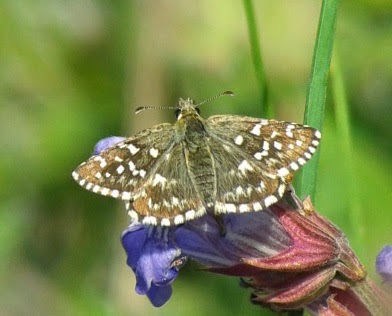

This could be any one of Large Grizzled, Yellow-banded, Grizzled, or Southern Grizzled.  If anyone wants to take a stab at it, be my guest!

There were also a lot of Italian Marbled White about, but they rarely alighted.

After a while, I came across a crossroads, complete with a board and map. It was needed, as I had no map of my own!  With this I was able to formulate a circular route back.

This route took me into some relatively birdless Hornbeam woodland.


There were some Marsh Tit and Short-toed Treecreeper in there, plus a worn Green Hairstreak, doing it's best to look like the rare Provencal Copper!  Also a Pearl-bordered Fritillary.


Back out into the open again, and yet more bewildering Fritillaries to get my head round, such as this female Spotted Fritillary (there were also males around, easily identified as being the brightest orange of the lot).


Best of all though, was several Queen of Spain Fritillary.


There was a good selection of raptors around, with a Hobby whizzing by, a distant soaring Short-toed Eagle, and a single female Honey Buzzard, which plunged down into a small copse of trees, presumably to search for Wasp nests.

Whilst under a canopy of trees, I heard some Bee-eater calling, but they sadly went unseen.

There were a great variety of day-flying micro-moths about, but most went unidentified, unlike this Chrysocrambus craterella.


The route I had to take back to base, led me down the steep rocky side of the mountain, on a very under-used and indistinct track!  The view over Formia and Gaeta from the top was spectacular though, and this is where I had lunch.


As I descended, I found a whole new community of wildlife surviving in this rocky environment, such as a fleeting shiny blue Forester moth Rhagades Pruni, and a more convincing Yellow-banded Skipper (the yellow bands are on the underside of the hindwing).


But, the star of the show was a Rock Thrush, which I found by following it's quite Blackbird-like song.  The heat haze was a pain though.


Along with Rock Bunting, that's another that we tried for and failed 2 weeks ago in France.

More trip ticks were a singing Woodlark, a Raven, and a bog-standard Northern Wheatear, proving my earlier brief sighting.

A fantastic walk, but I probably only successfully identified a fraction of the Lepidoptera seen!

In the evening, a quick look at the outside lights produced little new on the moth front, except this Hoary Footman.


Onto a ferry tomorrow.

Tuesday, 10 June 2014

Italy Trip - Days 3 + 4

2nd

I'd left the outside lights on overnight once again, and got a few moths.

The best being two of the migrants Palpita vitrealis, several Portland Ribbon Wave making me feel at home,


and the Emerald, Phaiogramma etruscaria.


Before leaving for our walk of the day, I had a quick scan of the surrounding mountains, and found a distant pair of Short-toed Eagle hovering.  Some consolation for missing the bird that was in the UK at that moment!

Also at this point, I saw two large Falcon soaring over the adjacent mountainside.  There was something about them which made me steer away from Peregrine, and towards Lanner, which is a speciality of Italy.  I was further confused by the sight of both birds seemingly catching insects in mid-air like Hobbies!  With that sort of behaviour, I decided they could surely not be Peregrine.

The destination for the day was the neighbouring ancient town of Gaeta.  Little wildlife interest I thought.

The view from the promontory was splendid.


But, what was more of a delight to my eyes, was that taking the place of Starlings sitting on the TV aerials in the town, particularly around the castle, was several singing Blue Rock Thrush.


Much better views than I got 2 weeks ago in France.

I was also delighted to discover that part of our walk route went through another country park, that of Monti Orlando.

As soon as I set foot here, I could hear a large Falcon calling.  It was difficult viewing through the trees, but I got some brief views of a male and larger female bird interacting.  The views I got weren't great, but I saw nothing to rule out Lanner, plus the noise they were making was unlike those I'd heard from Peregrine.  I listened to Lanner calls later, and I was forced to conclude that's what they were.  More on this later.

The insects again came to the fore, with Scarce Swallowtail, a gigantic Migratory Locust,


and the migrant moth Uresiphita gilvata being among the best.


In terms of birds, there were several Firecrest singing, a Short-toed Treecreeper, Sardinian Warbler were everywhere, and I had great views of Alpine Swift over the sea cliffs.


Also here, I think I finally nailed Pallid Swift, which I'd been on the look out for all day, with various possibles and probables up to that point.    Here though, there were birds nesting on the cliffs, and against the sea their brown-ness was particularly striking.

Back at home, and I found a discarded nest in the garden.  It's tiny size suggesting only Firecrest.


Later, rather than leave the outside lights on all night, I just put them on for an hour or so, and stood guard.

Yet more migrants were encountered including a male Gem, and a familiar Turnip, possibly also a migrant.

A Plumed Fan-foot was a nice find,


as was the fantastic micro Cynaeda dentalis,


but best of all, was the exquisite Eutelia adulatrix, looking like a mini Eyed Hawk-moth.


3rd

Today, we were off to the world heritage site of Pompei. 

It's an amazing place obviously, every detail so well preserved.


But as always, I was still thinking naturally, naturally!

From one of the perimeter buildings a Blue Rock Thrush sang, and the commonest birds of all were Tree Sparrow, and of course Italian Sparrow, which I finally got good views of.

In one of the ancient buildings I found this Roussillon Wave Idaea sardoniata,


and there was a great array of Beetles around, mostly unidentified.


But, I think this one is Clytra sexpunctata.


Whilst having lunch, we were visited by a Common Treecreeper.  Pretty restricted in range in these parts by all accounts.

Best bird of all though was a Hoopoe, which was seen in the only green space in the 'city'.

On arrival back at home quite late, I had another quick stint by the outside lights, this time producing only the familiar, with Small Blood-vein,


and a pale form of Small Dusty Wave.


Up to the mountains tomorrow!

Italy Trip - Days 1 + 2

31st May

I wasn't totally sure what I was expecting from Italy, particularly in regards to the wildlife.  I suppose I was not expecting much to be honest, particularly as it's rarely mentioned as a destination for a wildlife holiday.  On top of that this was a family holiday, and I was doubtful that I was going to get much opportunity to get out to the best wildlife sites.

We (myself, my brother, mother and step-father) touched down in Rome late-morning, and immediately I was on the lookout for birds from the car, as we made the 2 hour journey south to the town of Formia.

Zitting Cisticola could be heard singing from any small patch of grass by the roadside, and plenty of Hooded Crow and a Black Kite was spotted.  Lots of Sparrows were heard and glimpsed, which of course were going to be Italian Sparrow, so the first lifer (depending on which authority you listen to of course!).

We stopped briefly near our rented villa by a flower-rich verge.  Straight away, quality was found with a Spotted Clover day-flying moth, and of course the Carpenter Bee Xylocops violacea.  Despite their abundance throughout the week, this was the best shot I managed!


As we pulled up to the house, I spotted something bold flitting about an Oleander bush.  As soon as I could, I headed out there to take a look.  It was soon found, and it was the stunning moth Nine-spotted.  There are a couple of similar species, but I think the wide yellow band on the abdomen suggests it to be the commoner, Amata phegea.


I went on to see plenty more throughout the week, particularly in our garden.  Talking of it, this was the view from our garden, across to the town of Gaeta.


Besides the Nine-spotted, there was plenty of stuff to be found here.  It was full of Olive trees and various flowers, including these commanding Cacti.


Even more dynamically, there were plenty of butterflies flitting about, including the Cleopatra.  Although at rest they closely resemble Brimstone, in flight they are unmistakable with bright red patches in the centre of the upperwing.


Along with Wall Brown, they proved to be commonest butterflies throughout the week.

There were a few birds around too, with a Sardinian Warbler singing in next-doors overgrown garden.  Also a few Serin, and the ubiquitous Swift, which is probably the commonest bird here.  I was desperately scanning the flocks in the hope of Pallid, which are in this region.  Instead I found an Alpine Swift cruising overhead, dwarfing the commons.

A Peregrine was a fitting end to the day, steeling in and scattering the vast Swift and hirundine flock.

In the local supermarket, some drinks companies know exactly how to win my favour.


1st June

Last night, I left the outside lights on in the hoping of attracting one or two moths.

It worked, with a decent selection sitting on the wall. 

One or two Geranium Wave Idaea eugeniata,


plenty of the Bee Moth-like Lamoria anella,
 

a few Lustrous Least Carpet Idaea filicata,


a single Least Black Arches relative, Nola chlamitulalis,


an unidentified Bee Moth-like individual, possibly a female Lamoria anella,


and lots of Rush Veneer.


Incidentally, the number of migrant moths (from a UK perspective) like the latter, was very great.  How many of these were locally-bred, and how many had come from Africa, I'm not sure.  Some more of those later.

Other than that start, there was little wildlife watching for the rest of the morning as we had a walk round the town.  The conditions were already scorching hot.

I did find this Weasel's-snout, a rare plant in the UK.


As well as this familiar Lulworth Skipper.


In the afternoon, we went somewhere right up my street, the country park of Parco di Gianola.

The woodland there was impressive.


And carpeting it was plenty of Ivy Broomrape.


There were a few more interesting butterflies at this site, such as familiar Swallowtail, and less familiar Mallow Skipper, and Ilex Hairstreak.

I also found this stunning large caterpillar feeding on Broom, which turned out to be the larva of the rather dull noctuid, Apopestes spectrum.


There was a good view from the end of the head.


The grassland here was alive with interesting insects, such as this bold Crambid moth Angustalius malacellus.


And this pretty Flower Scarab Oxythyrea funesta.


Plus, there were lots of Burnet Moths of at least two species present.  The Transparent Burnet (of the nominate subspecies, not as 'transparent' as the British subspecies) was far the commoner.


One of the most obvious creatures here, and indeed in much of the rocky and even urban areas around the place, was the Wall Lizard.  The sound of them scuttling for cover from the edge of paths was an almost constant accompaniment to our walks.


There were a number of Roman ruins at this site, though the amount of mosaic remaining was rather pitiful.


We found ourselves in a tiny Roman harbour, and this turned out to be a good place for rock pooling.  There were lots of Sea Anemone, which looked their most stunning out of water.

 
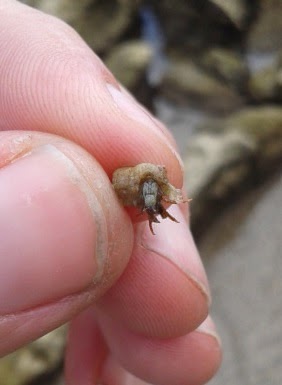
 Plus, I somehow spotted this minute Hermit Crab scurrying amongst the silt.


The route back through the woodland took us past a colony of Alabonia geoffrella. A species I've noted in the UK and France in the past.


Before we made it home, we went up the road to a holy shrine, which happened to be in a cave.  The place was full of Bloxworth Snout


In the evening I again put on the outside lights, and held a vigil by them for a while.

To my surprise, I spotted a number of Firefly flitting about the place, flashing their bioluminescent final segment to their body.  I had no idea we had them in Europe.  Turns out they are closely related to our Glow-worm.


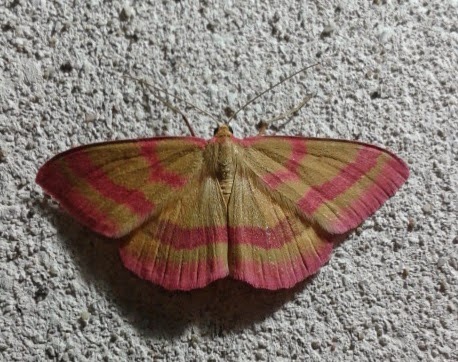
A moth did eventually show up, and it was worth waiting for.  The stunning Narrow Rose-banded Wave Rhodostrophia calabra.


A promising start to the trip!