The Portland Naturalist

The Portland Naturalist

Tuesday, 8 July 2014

Premium Petrel

Various little walks around the island have produced the following in the last week.

A search of the rough grassland at Suckthumb Quarry on the 2nd revealed my first Pammene gallicana sitting on its larval foodplant Wild Carrot, providing me with a helpful clue to its identitiy.


The next day I did a quick circuit of Blacknor, where Marbled White were almost swarming.  I came across this mystery cocoon amongst the grass, looking like a giant Burnet Moth cocoon.  It turned out to be a Drinker moth.


On the 5th, I found a patch of Nettles at Barleycrates Lane alive with Ladybirds and their larvae.  I was fully expecting them to be Harlequin, but to my delight, they were all Seven-spot Ladybird, some newly emerged.


Now, onto my Little Tern wardening adventures.

On the 28th June, I was delighted to see the first two chicks taking flight, or be it reasonably clumsily. 

A male Kestrel was emerging as enemy number one of the colony.  The wardening team have come up with all sorts of novel ways of scaring them off!


On the 5th, I was joined by someone else to help keep an eye out for the Kestrel.  This time, the bird was far more threatening, but luckily we were able to keep him relatively quiet by providing supplementary food at a nearby favoured perch.  The most difficult job was stopping Gulls from stealing the food (we weren't completely successful!).  At least 15 Little Tern chicks now fledged.  Once again, I was treated to a fantastic sunset.


Yesterday

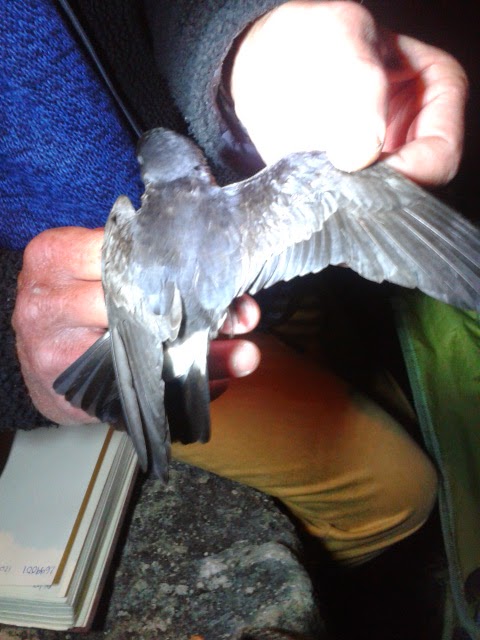
I've been hoping for a while to get out down to the Bill to join the Obs team whilst ringing Storm Petrel, but one thing or another has prevented me from doing so. Finally got the opportunity to go yesterday evening, and I took my moth net just in case it would come in handy.

As I waited for Martin to arrive, I started searching for moths.  The very first moth I netted was a Large Tabby, a lifer!


We set up the mist-net about 11 and started the tape lure, and it was then just a case of waiting.  Meanwhile, I turned my attention back to moths.  Nothing that unusual seen, but the beautifully calm conditions really had brought the moths out, and they were almost swarming around the sparse vegetation (the majority being Metznaria lapella around the Burdock plants).  This strikingly fresh Crescent Dart was on the toilet block.


A couple of surprise finds whilst mothing were a single Glow-worm.


And a very confiding Hedgehog.


After a little time I returned to the trapping area, only to find the first Storm Petrel had just hit the net!  Great timing!

What a great bird to see up close (shame my camera struggled with the light).


They really are tiny, and rather cute!


The rain then started, and we decided it was best to cut our losses, so no more birds to be had.  Still, it was a fantastic experience.  A big thanks to Martin.

Things are picking up slowly on the migrant bird side, so I think I'll restart my early morning birding soon.  If an Albatross isn't going to rouse me, nothing will!

Tuesday, 1 July 2014

Eagley Awaited

The Short-toed Eagle first appeared in the UK over a month a go, but various things have stopped me trying to see it.  These include me being away, work, occasional disappearances of the bird, plus a lack of enthusiasm on my part having seen them frequently in France and Italy very recently.

So, despite the bird having been a lot closer to me during it's stay, I finally had the chance to go for it on Sunday, whilst it was 150 miles away at Ashdown Forest, E. Sussex.

I headed to the Long car park at Wych Cross with Keith Pritchard, after a 3 hour drive.  The bird was last reported here yesterday afternoon, but I did wonder whether it's other haunt of Gills Lap may have been a better bet.  There were a few other birders at Long car park, but I hoped that there were some staking out Gills at the same time.

I'd never been to Ashdown before, and it looked a fantastic area.  The site was full of small birds, including Tree Pipit and lots of Redpoll.  A Red Kite lazily flapping overhead had us going for a second.

The weather wasn't perfect, with a cool breeze blowing and complete cloud cover. Would the bird really want to hunt reptiles in these conditions?

We were there for a few hours, before the fabulous Short-toed Eagle suddenly appeared circling really quite close.


It drifted up high before dropping down into an adjacent valley.

It made one more brief appearance above the trees, before dropping down once again.


This time, someone found it sitting in a dead tree, and I got good views in the scope of it's unique big-headed shape.  I never saw one on the deck abroad.

Finally, it took to the air again, this time flying up over us, and started hovering right overhead!  I never dreamt we would get views like this (despite the poor light)!


It clearly was having no luck finding food here, so a couple of hours after it first appeared, it soared up to a great height before bee-lining it's way north-east, presumably towards it's other favoured area around Gills Lap.  What an encounter!


So worth the long trip.

I really am amazed that I got the chance to see this bird, after it disappeared from Dorset three weeks ago! 

Wednesday, 25 June 2014

One good Tern deserves a Moth-er

Ages since my last non-away trip post, but wildlife excursions have been few and far between.  We start with a day that fell between my two trips abroad.

27th May

I set up at the West Cliffs in the hope of some late vismig, not expecting a great deal.  At one point I noticed four distant birds flying with a bounding flight towards Southwell Business Park.  I couldn't make out any colours, and the shape was indistinct, but I put them down as Skylark.

After giving up, I checked Twitter and found that a party of four Bee-eater had been commuting around the south of the island for last hour or so.  They had to be the birds I saw earlier!  I immediately went back out to try and find them again. 

Almost immediately I found four very promising looking birds flicking about behind Southwell Business Park, again too distant to pick out any detail.  I contemplated trying to get closer, but with them being so mobile, I thought that was a bad idea, and I instead stayed put in the hope they might fly in my direction.

They had been out of view for quite a while, when I thought I glimpsed one over Southwell, heading north.  Not long after, I glanced over towards Suckthumb Quarry, only to find all four Bee-eater hawking over it!

I jumped in the car and zoomed round there.  They weren't immediately obvious, but as I jumped up on one of the boulders by the entrance, they all flew up from a Bramble bush!  They flew around a bit, then headed off north towards the windmills.

I think me seeing my first ones in France just last week definitely helped me initially pick them up at distance from their flight action etc.  A cool UK tick!

8th June

I was in Surrey today in transit from Italy, and due to head back to Dorset.  I was hoping the Short-toed Eagle was going to be pinned down in the New Forest, so I could do a conveniently-placed twitch.  Sadly, it wasn't to be, though as I was seeing them literally two days ago in Italy, I wasn't too disappointed.

Instead, I headed to my beloved Tice's Meadow, not expecting a great deal.

It was nice to see the breeding Black-headed Gull and Common Tern doing well on their new raft.

Suddenly, I found a Little Tern flying around amongst the close Terns.  That's two short visits to the site in a month, and two Surrey rarities!  Also a first for the site I think.

It stayed about for a little while, before seemingly heading off high North-east.  I later discovered it had earlier been at nearby Fleet Pond.

13th

A new arrival was worth heading for at the Bill.

As soon as I got to the Top Fields, I could hear the Thrush Nightingale singing it's incredibly varied and powerful song.  I set up for a vigil, as it sang from very dense scrub.

While waiting, there were a number of Magpie Moth flicking about, the first time I can recall seeing them flying actively in the day.


Myself and the rest of the small crowd kept watch for some time, but despite several further enthusiastic periods of song, the bird failed to show itself.  Not all that surprising really.

I headed back home via various sites in the hope of bumping into the Hooded Crow that had earlier flown north from the Bill.

In Suckthumb Quarry I came across a Thistle Ermine.


Also here, I found a plant I didn't immediately recognise.  All pointers seem to suggest it was Marsh Pea, which is very rare in Dorset.  More on this later.


14th

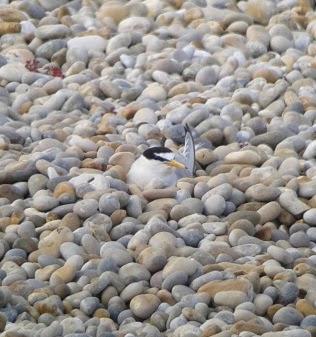
This evening was my long-awaited first guarding of the Chesil Little Tern colony.

They were great to watch, chasing everything that even came close to the colony, even Great Black-backed Gull!

They are doing so well, with 18 chicks at this point, and loads of eggs about to hatch.  I was keeping a close eye on two particular pairs that were next due.


There was plenty of other birds to be seen, such as a surprise fly-over Redshank, and a Gannet in Portland Harbour oddly.

The other interesting sighting concerned a summer-plumaged Plover which was initially thought to be a Grey.  But, when seen head on, it had a distinct golden tinge to it, something which is also evident in the pics I took (particularly the first one).


 Seen close-up, it clearly had several yellow feathers in it's crown and mantle.  I was seriously thinking it may be a 'lesser' Golden Plover.

But, it was later flushed as the Little Tern project co-ordinator Morgan (who incidentally, was also convinced the bird was a Golden Plover sp.) went to check the colony, and it revealed itself to be a Grey Plover with its call and underwings! 

Presumably, I was caught out by the fact that I've just not studied summer-plumaged Grey Plover in that much detail before!

I watched the sunset from my beach-top vista.


It was at this point when the Chesil Hare began to show themselves, and the Terns went just as mad at them when they entered the colony as when the Gulls do!


Just before I was about to leave, I took a last glance at pair number 8, only to see the bird on the nest looking very restless.  Eventually, I got a glimpse of a newly-born chick sticking its bill out the edge of the nest.  New arrivals!

15th

I found a Drinker moth caterpillar on the pavement whilst out working.


16th

After a couple of missed opportunities (including me failing to find the Grove pig farm!), I finally managed to see the long-staying Hooded Crow at the Grove.  It took a while to appear, but eventually showed itself among the flock of 80 or so Carrion Crow.  A nice Portland tick yes, but its not within my patch.  Its flown over the patch several times now, without me getting on it! 

21st

My second stint watching the Little Tern was less eventful than the first, but it was great to see 55 chicks doing so well, and on the dead calm sea, the adults were finding it so easy to catch fish.  At one point, one pair brought back three fish in the space of five minutes!

They are getting big now (for a Little Tern!).


22nd

Straight after the Terns, I headed to Broadcroft Quarry to see how the moth trapping was going, on a Butterfly Conservation event.

It looked promising in warm conditions.

The next morning we emptied the three traps.


The total of 120 odd species was one of the highest I've ever experienced.  Despite this, there were no new macros for me, but there were a few good micros.  Some of the lifers for me were Aethes beatricella, Pelochrista caecimaculana, and Delplanqueia dilutella.
 
After that, we went on a butterfly walk.  Among the highlights were Small and Silver-studded Blue.
 
Also among the highlights were the Shieldbug Eurygaster testudinaria.


Plus, I was finally able to solve the 'Marsh Pea' mystery, as the plant was everywhere here.  It turned out to be Slender Tare, which is a speciality of the site.  Not as rare as I'd hoped, but still a lifer for me.


Not a great deal of wildlife watching on the horizon, though there are a number of moth events coming up, and will I finally get the chance to see that pesky Short-toed Eagle?

Thursday, 12 June 2014

Italy Trip - Days 6 - 8

5th

We were to take to the sea today, heading two hours off the coast to the island of Ventotene.

We'd only just left port, when an Audouin's Gull flew past.  I knew they were in the area, but had no idea they'd be this easy!

Just as we were leaving the bay, a fantastic Cory's Shearwater was flushed from the front of the boat and I got good views.  Miles better than those I'd got off The Camargue two weeks ago.  By this time the Audouin's count was three, but we then suddenly hit a dry patch.

In fact, apart from the odd Yellow-legged Gull, and oddly, a Pallid Swift flying about way out at sea, I didn't spot any other birds till we got close to the island .

Shearwaters presumably nest on the island, so it wasn't much of a surprise to see one or two Yelkouan Shearwater briefly.

Once on the island, we headed for the far end and highest point.  The place was tiny, smaller than Portland in fact.  Imagine my delight when I discovered there was a Bird Observatory there!  I had no idea!  I soon realised that an island in this location was bound to be a migration hotspot.

My suspicions were solidified by finding Spotted Flycatcher and Reed Warbler in quick succession, neither in breeding habitat.  Clearly migration was still occurring.  What else might be around?

Plenty of great insects as to be expected now from this region, such as this female Rhinoceros Beetle Oryctes nasicornis.


And the black and red Shieldbug Graphosoma lineatum (similar to G. italicum that I saw in France)


We did come across the Bird Observatory eventually, though it turned out to be more of an interpretive visitor centre than the UK version, and you had to pay to get in, so we gave it a miss.

Not long after passing the centre, I flushed a large warbler from some roadside bushes.  I watched it for ages into the sun, as it preened on an exposed branch.  It had a large bill, and I was thinking it must be a Hippolais, but it's plumage seemed rather brown.  I never got enough on it frustratingly, but I wonder whether it could have been an Eastern Olivaceous Warbler (a late migrant, and they breed due north on the Adriatic coast).  One that got away!

We made it to the far end of the island, which was a mass of Broom scrub


The butterflies were particularly impressive here, with plenty of Swallowtail, as well as this mating pair of Long-tailed Blue.


There were also Hummingbird Hawk-moth absolutely everywhere!  Clearly the precursor to the mass migration occurring in the UK at the time of writing.


We made our way back to the tiny harbour after our lunch. 

A Peregrine soared overhead, and a large passerine calling like a Tawny Pipit heading out to sea towards the adjacent islet of San Stefano, was probably a Short-toed Lark.

After a refreshing swim in the sea (lots of interesting fish seen, as well as a bizarre Sea Cucumber!) , we caught the Ferry back (Ventotene on right, San Stefano on left).


On the trip back, I saw way more Shearwaters than on the trip out, with brilliant views of both species.

Towards the end, one of the local Audouin's Gull followed us into port.


The evening was one of the only calm ones of the week, and I was able to sit out in the garden and hear both Nightjar and Scops Owl calling from the other side of the valley.

6th

The plan today was to head back up into the Monti Aurunci mountains.  As it turned out, we went very close to where I went walking before.  As a result, I ended up seeing much of the same as that walk, though I tried my best to seek out different habitats where possible, keeping to dry grassland and woodland.

Plants were top quality here, with familiar Nottingham Catchfly,


The wonderfully-named Bastard Balm,


And, at last, a few Orchids, including the familiar Pyramidal, the very unfamiliar Bug,


plus both Violet and Common Bird's-nest Orchid.


The Golden Oriole I'd heard last time was singing much closer on this walk, and I think I came very close to catching a glimpse, but not quite!

Short-toed Eagle were around, along with Cirl Bunting, both Treecreeper, and my first Redstart and Stonechat of the trip.

The highest point again gave great views.


The Lepidoptera again featured highly, with more Spotted Fritillary (a male this time),


The brightly-coloured Scarce Forester,


And, I finally managed to get a shot of the hyper-active Scarce Swallowtail.


A few more familiar 'leps' included a Cream-spot Tiger,


And Meadow Brown, though the ones around here seem to have larger secondary eye-spots on the hindwing.


The best bird turned out to be a single singing Western Bonelli's Warbler, a species I expected to be commoner.

A few more interesting insect finds included this unidentified large Scarab Beetle.


a caterpillar of the Burnet moth Zygaena cynarae.


and the large Assassin-bug Rhynocoris iracundus.  Red and black seems to be a common theme among the insects round here!


A short trip to the nearby village of Maranola, produced yet another Blue Rock Thrush.

In the evening, I again saw two Falcon soaring on the nearby mountainside.  One drifted towards the house, and gave me great views circling right over the garden.  I was expecting to see the ginger crown, barred rump, and dark underwing covert bar of a Lanner.  I didn't, it was a Peregrine!  Had all the Falcons I'd seen up to now been Peregrine?  Not sure, but I think it's highly probable.  Shame.

7th

This morning, we made the trip back to Rome airport, with a little visit to the famous monastery of Montecassino in between.

From the car, I saw Black Kite and a very close Honey Buzzard before we reached the end of the line.

A shame I didn't get the opportunity to get out to a wetland, but I had a great week.  With that in mind, the bird total of 75 is really very good.  However, it was all the incredible insects, and particularly butterflies and moths, which made it for me.

In the end, it was a brilliant trip with a loads more wildlife than I was expecting.  There doesn't seem to be quite the ecological tradition of other countries, with only a small number of nature reserves.  The people don't seem to be quite so interested in wildlife than elsewhere either   The reserves we visited, including the national park, were virtually deserted.  But, where there is wildlife, it is special.

The likes of southern France and Spain probably have more bird species and in greater numbers than Italy, which is why it's not really mentioned as a birding destination.  But, with all the wonderful non-birding places to visit (Pompei, Montecassino, Rome etc.), I think it's an ideal location for a holiday with non-birding relatives. 

If you do go, I'll give you just one head up, Italian drivers are maniacs!